
To measure AI decision-making, start with a harder question: did AI improve the decision, or only increase the activity around it?
One senior executive was proud of exactly that progress. Yet a review of the previous quarter revealed something important: no major decision had been made faster, no strategic call had changed, and no risk had surfaced earlier.
The organization had increased AI activity, but it had not improved the way decisions moved across the leadership team.
This is where many AI initiatives lose sight of value. A tool can make one task faster while the wider decision remains slow. Research may arrive sooner, but finance still challenges the assumptions late. A proposal may be drafted in minutes, but legal, operations, product, and sales still rebuild the context separately. The output improves while the decision system stays the same.
Deployment Is Moving Faster Than Evidence
Evident’s Q2 2026 research tracked 93 new AI use cases announced by 50 global banks, a quarterly record. Only 27% of those use cases disclosed an outcome, down from 41% in the previous quarter.
That research does not tell us whether each bank improved cross-functional decisions. It does reveal a broader measurement gap: organizations can scale AI faster than they can show what changed.
The answer is to measure the decision, not the tool.
Why Local Gains Disappear
Cross-functional decisions are difficult because no single team controls the whole journey. One function gathers evidence, another evaluates risk, another owns delivery, and a senior leader may hold the final authority. Each group can improve its own task while the overall process gains very little.
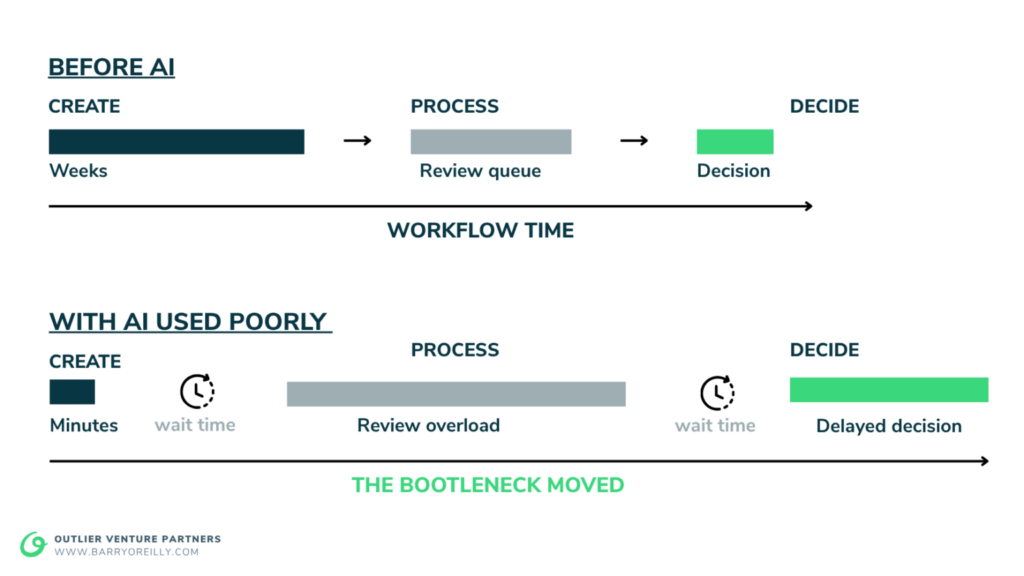
The diagram illustrates the Processing Pass-Off. AI reduces creation time from weeks to minutes, but the work still waits in the same review queue and the final decision arrives no sooner. The task gets faster while the wider workflow remains unchanged.
A marketing team might use AI to prepare a customer analysis in an hour instead of a day. If product questions the data, finance applies a different forecast, and legal only sees the proposal at the end, the decision may still take three weeks. The saved time is real, but the business value remains trapped inside one step.
This is why measuring individual productivity is not enough. Leaders need a baseline for the complete decision, from the first signal to the resulting action. Only then can they determine whether faster tasks are producing faster, better decisions.
Measure the Whole Decision Cycle
A useful way to measure cross-functional decisions is to examine the full decision cycle: Sense, Think, Decide, Act.
AI is useful when it strengthens this loop across functions, rather than optimizing an isolated task inside it.
Sense. Did the right people identify an important signal earlier? Measure the time between a change appearing and the team recognizing it. Track late surprises and avoidable escalations.
Think. Did the functions involved build a shared view faster? Measure preparation time, duplicated analysis, and the effort spent rebuilding context. A stronger process makes the options, assumptions, and trade-offs visible to everyone involved.
Decide. Did a clearly accountable owner make the call sooner? Measure total time to decision, the number of deferrals, and how often decisions are reopened. Faster analysis means little when the meeting still ends with a request for more information.
Act. Did the decision lead to coordinated action and a better result? Measure the time from decision to action, whether weak experiments stop quickly, and whether the intended customer or business outcome improves.
Across the full loop, keep two questions visible:
Who owns the decision? What evidence will show that it worked? Without clear ownership, cross-functional work turns into a series of handoffs. Without an agreed outcome, speed becomes the only visible result.
What Leaders Can Do Next
Start with one recurring cross-functional decision. It could be a pricing change, a product launch, a customer escalation, or a hiring plan.
- Review the last three examples and record how long the full decision took.
- Map where context was rebuilt, ownership became unclear, or the decision stalled.
- Name one accountable decision owner and the functions that must contribute.
- Choose one stage of the decision cycle where AI could help.
- Define the business evidence you expect to see within 30 days.
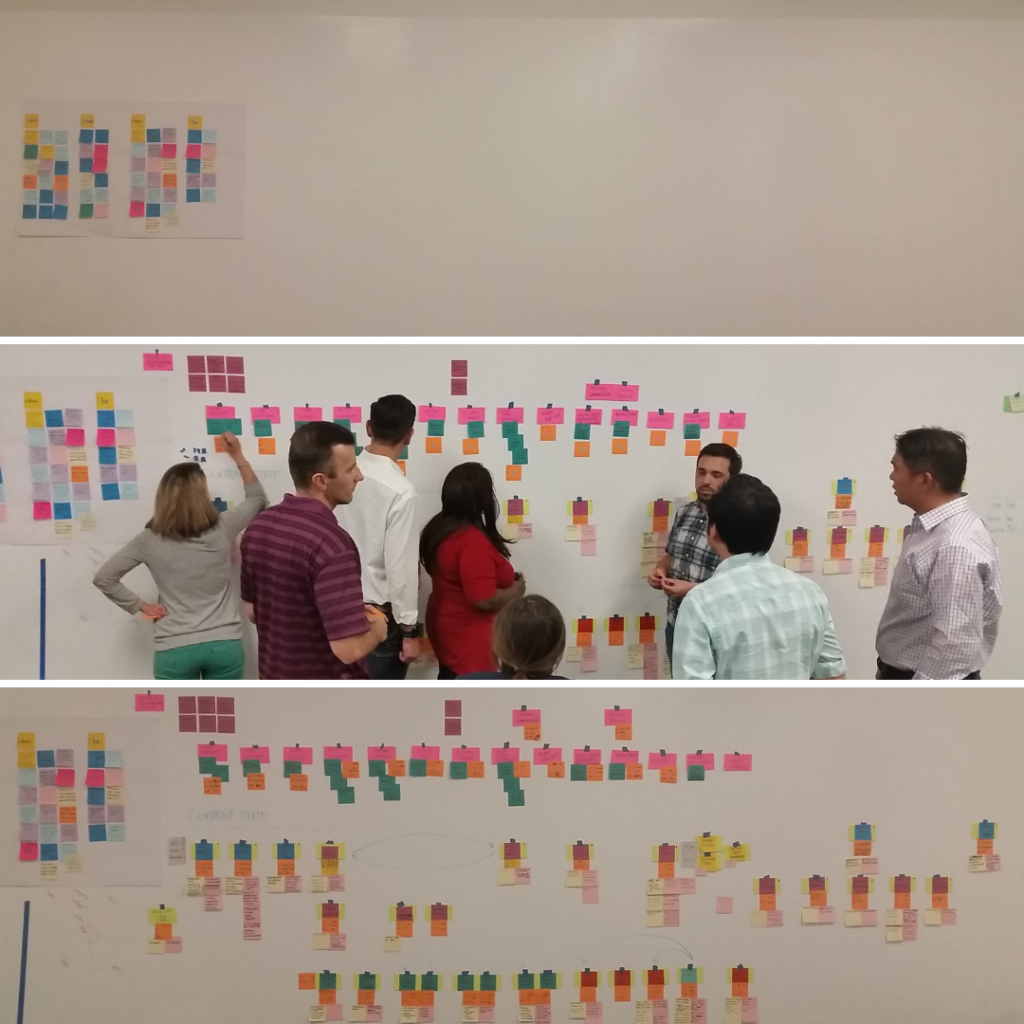
Then compare the new result with the baseline. If AI produces more material but the decision takes the same time, requires the same approvals, or leads to the same outcome, the organization has not improved.
Artificial organizations are built by redesigning how judgment flows between people and machines. The goal is a stronger judgment infrastructure: relevant signals surface earlier, teams understand the trade-offs, owners make clearer calls, and action follows. That is how leaders can tell whether AI is improving cross-functional decisions, rather than simply adding more activity around them.
Artificial Organizations Is Available in German
KI als Denkpartner brings the ideas from Artificial Organizations to German-speaking leaders exploring how human judgment and machine intelligence can improve decisions and ways of working.
Translated by Ignatius Furger, the German edition is available through Amazon Germany.
FAQs
Q1. How can leaders measure whether AI is improving cross-functional decisions?
Establish a baseline for the complete decision cycle before introducing AI. Then measure whether signals are identified earlier, shared analysis takes less time, decisions are made sooner, and action produces a better business or customer outcome.
Q2. Why are AI adoption and productivity metrics not enough?
Adoption shows that people are using AI, while productivity metrics may show that one task became faster. Neither proves that the wider workflow, decision, or organizational outcome improved.
Q3. What is the Processing Pass-Off?
The Processing Pass-Off occurs when AI helps one person complete a task faster but transfers more verification, interpretation, or decision-making work to someone else. The output arrives sooner, but the workflow and final decision remain slow.
Q4. What should organizations measure before introducing AI?
Organizations should record the current decision cycle time, preparation effort, handoffs, approvals, duplicated analysis, rework, ownership, and intended business outcome. These numbers provide the baseline needed to prove improvement.
Q5. Who should own an AI-enabled cross-functional decision?
A single business leader should be accountable for the decision and its outcome. Other functions can contribute evidence and expertise, but shared participation should not result in unclear ownership.
Q6. What evidence shows that AI has improved a decision?
Useful evidence includes shorter decision cycles, fewer deferrals, less duplicated analysis, faster action, earlier identification of risk, and measurable improvement in the intended business or customer outcome.
References
- Evident Insights. “AI Use Case Trends in Banking.” July 13, 2026.
- O’Reilly, Barry. Artificial Organizations. 2026.
- O’Reilly, Barry. AI Adoption Has Already Happened. Measuring AI Outcomes Has Not. Barry O’Reilly.
Most leaders experimenting with AI start in the wrong place. They start with productivity.
They ask AI to write emails, summarize documents, or generate presentations. These capabilities are impressive and useful, but they only scratch the surface of what AI can do for leadership.
The real opportunity is not productivity, it is thinking.
The leaders gaining the greatest advantage from AI are not using it primarily to execute tasks faster. They are using it as a thinking partner to sharpen judgment, pressure-test ideas, and prepare better decisions.
This shift is subtle, but its impact is profound. When AI becomes part of a leader’s thinking process, it begins to influence how decisions are formed, how problems are framed, and how organizations move from insight to action.
The Hidden Bottleneck in Leadership
Leadership has always been a thinking profession.
Executives are paid not to produce documents or process information, but to exercise judgment under uncertainty. Yet much of a leader’s time is consumed by work surrounding decisions rather than the decisions themselves.
Research consistently shows that executives spend enormous amounts of time preparing for decisions: gathering information, summarizing conversations, and reconstructing context before meetings.
In the Artificial Organizations AI Executive Study (2025), leaders reported spending between 30–40% of their week preparing for meetings, gathering information, and synthesizing context before key decisions. This reflects broader industry research from HBR showing senior executives spend more than 23 hours per week in meetings, with additional hours spent preparing for them.
This preparation work is necessary, but it creates friction. When leaders spend hours assembling context, they have less time for the work that matters most: interpreting signals, exploring alternatives, and making confident decisions. This is where AI changes the equation.
The Shift from Tool to Thinking Partner
Most people use AI like a tool. They give it a prompt and expect an answer.
Leaders who unlock its real power use it differently. They use AI to interrogate their thinking.
Instead of asking AI to produce finished output, they engage it in a dialogue that helps refine their judgment. They explore questions such as:
- What assumptions am I making here?
- What alternative interpretations exist?
- What risks might I be overlooking?
- How would a skeptical stakeholder challenge this idea?
This process transforms AI from a generator of content into a partner in reasoning. Rather than replacing human judgment, AI amplifies it.
The Executive Preparation Advantage
One of the most powerful applications of AI as a thinking partner appears in executive preparation.
Consider how leaders traditionally prepare for a major meeting. They review documents, scan reports, read previous notes, and try to reconstruct what happened in earlier discussions. This process is slow and often incomplete.
With AI integrated into leadership workflows, preparation changes dramatically. Captured meeting transcripts, written updates, and research materials can be analyzed by AI to produce structured summaries of key issues. Leaders can then explore these summaries interactively.
- What decisions are pending?
- Where do opinions diverge?
- What information is still missing?
This approach dramatically accelerates preparation time while increasing clarity.
In the Artificial Organizations AI Executive Study (2025), leaders using AI-assisted preparation reported 30–50% faster decision cycles and significant reductions in time spent gathering information before meetings.
The benefit is not simply time saved, it is better thinking under pressure.
A Case Study: Preparing for the Executive Room
One executive featured in Artificial Organizations began experimenting with AI as a thinking partner while preparing for leadership meetings.
Previously, preparing for these sessions required several hours of work. The executive would review documents, read through email threads, and attempt to reconstruct the key issues discussed in earlier meetings before the next discussion began.
After integrating AI into the preparation workflow, the process changed.
Meeting conversations were automatically captured and transcribed. AI tools were then used to summarize prior discussions, highlight unresolved issues, and surface key themes that had emerged across conversations. Instead of manually reviewing multiple sources of information, the executive could quickly explore a structured overview of the situation.
Preparation time dropped from several hours to roughly ninety minutes.
But the most meaningful change appeared in the meeting itself. Instead of spending the early part of discussions reconstructing context, the executive arrived with a clearer understanding of the issues, the assumptions being made, and the possible decision paths ahead.
As a result, discussions moved more quickly to the substance of the decision. Questions became more focused, and the group was able to spend more time evaluating trade-offs rather than reviewing background information.
The executive later reflected that the biggest difference was not the time saved in preparation, but the quality of thinking it enabled: “I arrived prepared in a way that wasn’t possible before.”
Pressure-Testing Decisions Before They Happen
Another powerful application of AI as a thinking partner is decision rehearsal.
Leaders frequently enter high-stakes conversations where clarity, judgment, and executive presence matter—board meetings, investor discussions, and strategic reviews.
In these situations, the quality of preparation often determines the quality of the outcome.
To explore this further, we introduced a simple experiment with the same executive, the CEO-bot: an AI system designed to act as a challenging counterpart during preparation.
The system was configured to question assumptions, raise alternative interpretations, and surface potential counterarguments while the executive prepared for upcoming conversations with the CEO and board.
In practice, this meant the executive could test their thinking before entering the room. If a strategy had weaknesses, the system would highlight them. If a proposal lacked supporting evidence, it would prompt further exploration. If a line of reasoning was unclear, the executive could refine it in advance.
This process is not entirely new. Many experienced leaders already pressure-test ideas with trusted colleagues or advisors.
The difference with AI is speed and accessibility.
Instead of waiting for the next conversation with a peer or mentor, leaders can explore multiple perspectives immediately, refining their thinking in real time.
The result was noticeable. The executive entered discussions with clearer framing, stronger reasoning, and greater confidence in the arguments they presented. Colleagues began to comment on the clarity of preparation and the quality of contributions in leadership meetings.
Over time, this kind of preparation does more than improve individual performance. It strengthens the overall decision process of the organization.
Leaders arrive with clearer thinking. Conversations move more quickly to the real issues. And decisions happen earlier and with greater confidence.
The Research on Decision Quality
Research increasingly shows that organizations that make high-quality decisions quickly outperform competitors. Bain & Company’s work on decision effectiveness found that companies that excel at decision-making outperform peers financially by up to 95 percent.
Yet most organizations struggle to improve decision quality because the process surrounding decisions is slow and fragmented. Information is scattered. Context must be reconstructed. Perspectives are incomplete. AI reduces this friction.
When leaders have access to synthesized context and can explore issues interactively, they move more confidently from signal to judgment. This is where decision velocity and decision advantage begin to compound.
Thinking Systems, Not Thinking Alone
One of the most important insights from the Artificial Organizations work is that leadership is rarely an individual activity. Leaders operate inside systems. Information flows through those systems. Decisions move through those systems. Knowledge accumulates within those systems. AI allows organizations to design systems that support thinking itself.
Captured conversations feed into AI analysis. Insights are synthesized into decision briefs. Leaders explore those briefs with AI before making decisions. Over time this creates a feedback loop. The organization becomes progressively better at understanding its own information. Leadership thinking becomes more structured, more informed, and more consistent.
The shift to AI as a thinking partner does not require a massive transformation. It begins with small habits. Leaders begin capturing their meetings and conversations. They explore those transcripts using AI. They ask AI to challenge assumptions before making decisions. They use AI to clarify issues before entering important discussions.
Over time these habits reshape how leaders think. Preparation becomes faster, clarity increases and decisions accelerate.
The Competitive Advantage of Thinking Faster
In the coming decade, organizations will not compete primarily on who has access to AI tools. Those tools are rapidly becoming available to everyone. The real competitive advantage will come from how leaders integrate AI into their thinking processes.
Leaders who treat AI as a productivity assistant will see incremental gains. Leaders who treat AI as a thinking partner will experience something very different. Their preparation improves. Their reasoning sharpens. Their organizations move from information to decision faster than competitors.
We see this consistently in the leaders we work with through the Artificial Organizations programs and executive coaching. Once leaders begin using AI as a thinking partner in their leadership workflows, the impact becomes measurable. Executive preparation time drops significantly. Meeting context is reconstructed in minutes instead of hours. Leaders report clearer framing of strategic issues and greater confidence in the decisions they bring to their teams.
In the Artificial Organizations AI Executive Study (2025), leaders experimenting with AI-augmented decision workflows reported 30–50% faster decision cycles, along with meaningful reductions in time spent preparing for meetings, summarizing conversations, and gathering context before making decisions. Several executives also reported a noticeable shift in the quality of their leadership conversations. With less time spent reconstructing information, discussions focused more quickly on judgment, trade-offs, and action.
Over time this difference compounds. Decision velocity increases, decision advantage strengthens, and leadership itself evolves.
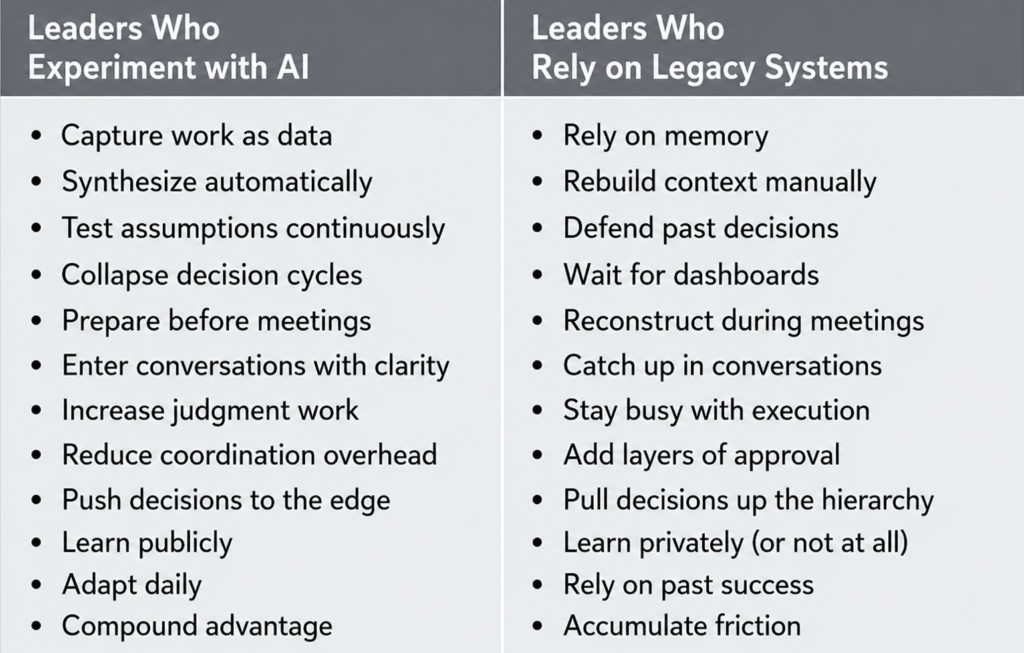
Organizations that redesign how leaders think with AI are not simply becoming more efficient. They are building a structural advantage in how quickly they interpret signals, explore options, and act with confidence.
And in environments defined by uncertainty and rapid change, thinking faster and deciding better may become the most important competitive advantage of all.
The Leadership Question for You
AI will not replace leaders. But it will change how leadership works.
The most effective leaders of the next decade will not simply manage people and resources. They will design systems that amplify thinking.
The question leaders must now ask themselves is simple. Are you using AI to produce more content? Or are you using it to think better?
Because the leaders who build AI into their thinking processes will not simply work faster.
They will make better decisions, faster than everyone else in the room.
FAQs
Q1. What does it mean to use AI as a thinking partner?
Using AI as a thinking partner means engaging it to refine ideas, challenge assumptions, and improve decision-making rather than just generating outputs.
Q2. How is AI as a thinking partner different from using AI for productivity?
Productivity use focuses on tasks like writing or summarizing. A thinking partner approach focuses on improving judgment, preparation, and decision quality.
Q3. Why is decision-making still slow in organizations today?
Leaders spend a significant amount of time gathering information, reconstructing context, and preparing for meetings instead of focusing on decisions themselves.
Q4. How does AI improve executive preparation?
AI analyzes transcripts, documents, and data to create structured summaries, helping leaders prepare faster and with greater clarity before decisions.
Q5. How can leaders use AI to improve decision quality?
Leaders can use AI to pressure-test ideas, explore alternative perspectives, and identify risks before entering high-stakes discussions.
Q6. What is the competitive advantage of using AI as a thinking partner?
Leaders who integrate AI into their thinking processes improve decision speed and clarity, creating a structural advantage in how organizations operate.
References
Most leaders begin their AI journey in the wrong place. They start with tools.
New copilots, new assistants, or automations based on the latest and greatest tool they heard about that week.
The result is predictable. Some productivity improves, but leadership performance rarely changes in a meaningful way.
That is because the real opportunity with AI is not tool adoption. It is leadership augmentation.
The leaders who accelerate fastest with AI follow a different sequence. Instead of starting with tools, they start by redesigning how they work.
In Artificial Organizations, I call this the 3T Model:
Traits → Tasks → Tools
This sequence matters more than most leaders realize.
When leaders invert it, they amplify noise. When they respect it, AI becomes a multiplier.
The Real Constraint in Leadership
Organizations today are drowning in information. Dashboards multiply. Reports increase. Data becomes more accessible than ever. Yet leaders are not experiencing greater clarity.
The constraint is not access to information. It is judgment capacity.
Leadership advantage today comes from two forces working together:
- decision velocity — how quickly leaders move from signal to decision
- decision advantage — how well-informed and pressure-tested those decisions are
Speed without insight creates chaos. Insight without speed creates irrelevance. When the two compounds together, leadership itself changes shape.
AI has the potential to dramatically improve both, but only if leaders redesign how they work.
The Mistake Most Leaders Make
When leaders first explore AI, they experiment with tools.
They try ChatGPT. They test Copilot. They experiment with Perplexity.
These tools can be powerful. But without a clear leadership system behind them, they often become another layer of complexity.
The real leverage does not come from executing tasks more productively. It comes from redesigning how decisions move through your system. That is where the 3T Model comes in.
The 3T Model
The 3T Model helps leaders align AI with how they actually think and work.
The sequence is simple:
Traits → Tasks → Tools
It is not a productivity framework. It is judgment infrastructure design.
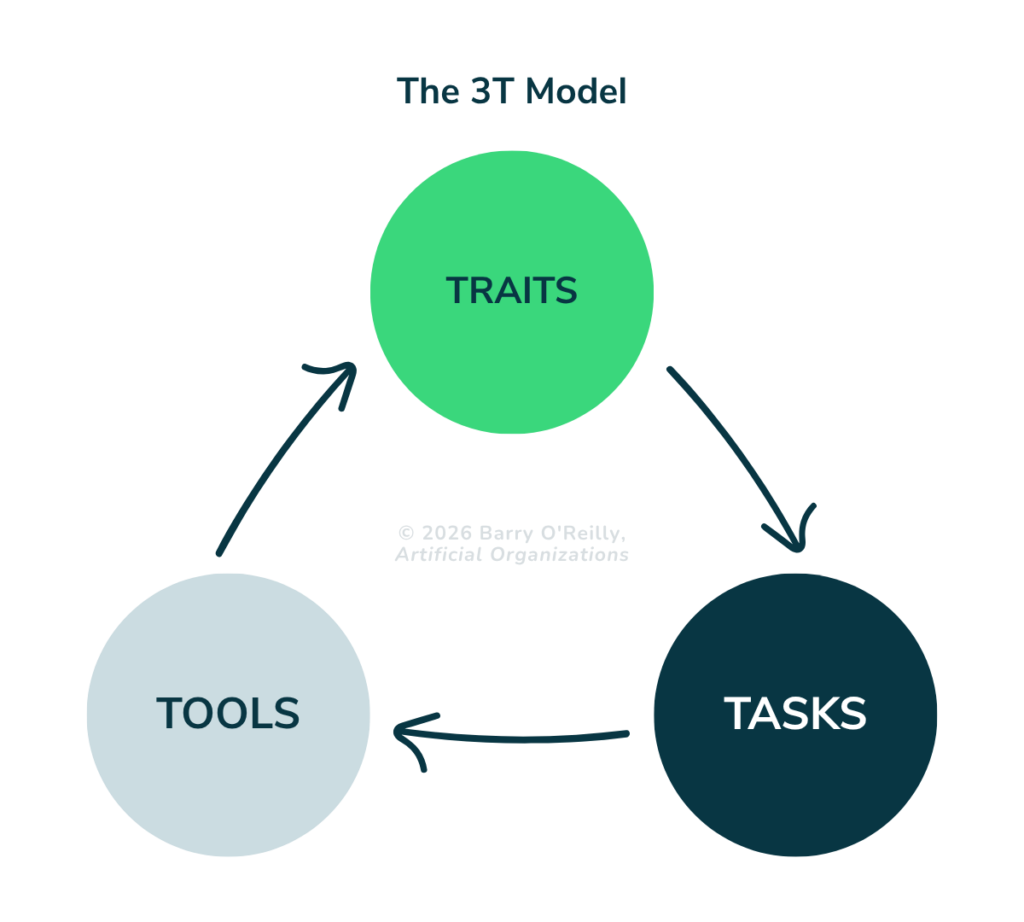
Traits: How You Naturally Think
The first step is understanding how you work at your best.
Every leader has natural cognitive patterns. Some leaders think best by talking ideas through. Others prefer writing, sketching, or analyzing quietly.
The book identifies several common leadership traits:
- verbal — talking, debating, storytelling
- visual — writing, mapping ideas, sketching
- receptive — listening and observing
- analytical — structured reasoning and problem solving
- physical — walking, prototyping, experimenting
These are not preferences. They are sources of leverage.
Most leaders never design their work around them. Instead, they inherit workflows that reward endurance, responsiveness, and visibility. AI flips that equation.
When machines handle administrative tasks such as capture, recall, and synthesis, leadership value centers on judgment. Understanding your traits is the first step to amplifying that judgment.
Tasks: Where Your Judgment Creates Value
Once leaders understand their traits, the next step is identifying their highest-leverage tasks.
Every leadership role contains two types of work.
High-leverage tasks:
- strategic thinking
- Synthesis
- Coaching
- Judgment
- Decision making
And what I call (necessary) time-suck tasks:
- typing notes
- rewriting updates
- hunting for documents
- summarizing conversations
- preparing slides
AI is built for these administrative tasks. You are built for the high-leverage work.
When leaders automate administrative friction, they create space for the work only they can do. This shift alone can dramatically increase leadership capacity.
Tools: The Last Step, Not the First
Only after leaders understand their traits and tasks should they choose tools.
When tools align with how leaders think and the work they need to perform, they become multipliers rather than distractions.
Different tools serve different leadership functions.
Large language models such as ChatGPT or Claude are excellent for synthesis, strategic framing, and decision preparation.
Research engines such as Perplexity or Elicit are useful for fast, cited research.
Custom prompts or AI agents can accelerate recurring decision workflows.
But the power move is not the tool, it is the discipline of aligning tools with judgment tasks.
The leverage isn’t in using more tools. It is in knowing which tool sharpens thinking for the task at hand.
AI as a Thinking Partner
The most powerful shift leaders experience is when AI stops being a tool they use and becomes a thinking partner.
Instead of asking AI to produce answers, leaders use it to sharpen their thinking.
- They clarify decisions.
- They pressure test assumptions.
- They generate strategic options.
- They rehearse arguments before entering high-stakes discussions.
This approach dramatically accelerates executive preparation.
In one case study from the book, Misty Shafer Sterne, the Vice President of Commercial Technology at American Airlines, the world’s largest airline, shared how she used AI as a thinking partner while preparing strategy and executive communication.
Misty recognizes that her best thinking doesn’t always happen in strategy sessions. Her best ideas often come while she’s moving–walking through an airport terminal or driving home—or in quiet moments between meetings.
Talking it out is her natural trait and a true talent. Once she started capturing voice notes and running them through AI, her thinking became a multiplier. She:
- shaped new geo-location operating models
- developed revenue ideas
- captured performance feedback for her team
- refined strategies far faster than before
At the same time, she noticed clear benefits:
- ideas stopped getting lost
- strategy work happened in micro-moments
- intuition turned into structured plans
- preparation time dropped dramatically
She didn’t find any more hours. She found leverage in small fractions of time compounded throughout her day.
We see this in numerous leaders we work with:
- Preparing research for a board presentation dropped from six hours to ninety minutes.
- Writing department-wide updates dropped from three hours to thirty minutes.
- High-stakes meeting summaries dropped from an hour to ten minutes.
The real benefit, however, is not time savings. It was clarity.
Misty used AI as a thinking partner and amplified her natural traits by pairing the right tasks with the right tools. As a result, she showed up feeling more prepared, more confident, and more present in leadership conversations.
The Executive Decision Engine
Most executive workflows follow the same pattern.
- Information is captured.
- Insights are summarized.
- Issues are classified.
- Decisions are distributed.
- Outcomes are tracked.
AI collapses the friction across this entire system.
For example, conversations from meetings, Slack threads, or emails can be captured automatically. AI can synthesize these inputs into structured decision briefs. Leaders arrive at meetings already prepared. Decisions are clearer. Follow-up becomes automatic. Over time, these workflows compound into a leadership operating system.
The Performance Impact
When leaders implement AI-augmented workflows effectively, the results are measurable.
Leaders in organizations adopting our AI leadership operating system report:
- 30–50% reduction in time from issue surfaced to decision made
- 2–3× increase in meaningful decisions per quarter
- 40–60% reduction in executive preparation time
- higher follow-through rates and fewer decision reversals
The biggest gain is not speed alone. It is confidence during uncertainty.
AI does not make leaders decisive. It removes the friction that keeps them indecisive.
The Real Transformation
The biggest shift leaders experience with the 3T Model is not technical, it is behavioral.
They stop treating AI as a productivity hack. They begin using it as a judgment infrastructure.
They capture their thinking. They pressure test ideas earlier. They arrive prepared. They decide faster. Over time, this produces a widening leadership advantage. Decision velocity increases, decision advantage improves and leadership presence strengthens.
The Leaders Who Move First
The leaders who adopt this model early will not simply become more productive. They will become structurally better decision makers.
They will show up to critical moments with clearer thinking. They will prepare faster than their peers. They will navigate uncertainty with greater confidence, and they will compound advantage over time.
The question leaders must now ask themselves is simple: are you experimenting with AI tools or are you redesigning how you lead?
Because the leaders who align Traits, Tasks, and Tools will not just use AI better.
They will outperform everyone else in the room.
FAQ
Q1. What is the 3T Model?
The 3T Model is a framework that helps leaders use AI effectively by aligning Traits, Tasks, and Tools to improve decision-making and performance.
Q2. What does Traits → Tasks → Tools mean?
It means leaders should first understand how they think, then identify high-leverage tasks, and only then choose AI tools that support those workflows.
Q3. Why do most leaders struggle with AI adoption?
Most leaders start with tools instead of redesigning how they work, which leads to more complexity without improving leadership performance.
Q4. How does the 3T Model improve decision-making?
It improves decision velocity and clarity by aligning AI with how leaders think and where their judgment creates the most value.
Q5. What are high-leverage tasks for leaders?
High-leverage tasks include strategic thinking, synthesis, coaching, and decision-making—work where human judgment creates the most impact.
Q6. How should leaders use AI in practice?
Leaders should use AI to handle administrative work like capture, summarization, and preparation, so they can focus on thinking, decisions, and leadership.
Reference:
- O’Reilly, B. Artificial Organizations.
- O’Reilly, B. AI as a Thinking Partner: Leadership & Decision-Making (Podcast with M. S. Sterne).
Many leaders experimenting with AI are discovering something surprising. The real value is not writing emails faster, summarizing documents, or generating presentations. Those improvements are useful, but they are incremental.
The real leverage of AI appears when leaders redesign how decisions move through their organization.
In Artificial Organizations, I describe this as the CTSA Model:
Capture → Think → Synthesize → Act
This model transforms AI from a productivity tool into decision infrastructure. When implemented properly, it dramatically increases decision velocity and decision advantage across teams.
The Real Bottleneck in Leadership
Organizations rarely struggle because of a lack of information.
The majority of companies generate enormous amounts of data: dashboards, analytics, reports, meeting notes, Slack conversations, and email threads. The challenge is not information scarcity. It is signal extraction.
Leaders spend an extraordinary amount of time trying to understand what is happening, what matters, and what decision needs to be made next.
Research from Bain & Company shows senior executives spend more than two days each week in meetings, with even more time spent preparing—gathering information, summarizing discussions, and reconstructing context before decisions are made.
This is not where leadership value is created. Leadership value is created when leaders interpret information, exercise judgment, and make decisions.
The CTSA Model removes friction from everything surrounding that judgment.
The CTSA Model
The CTSA Model describes how AI can support the natural flow of leadership work.
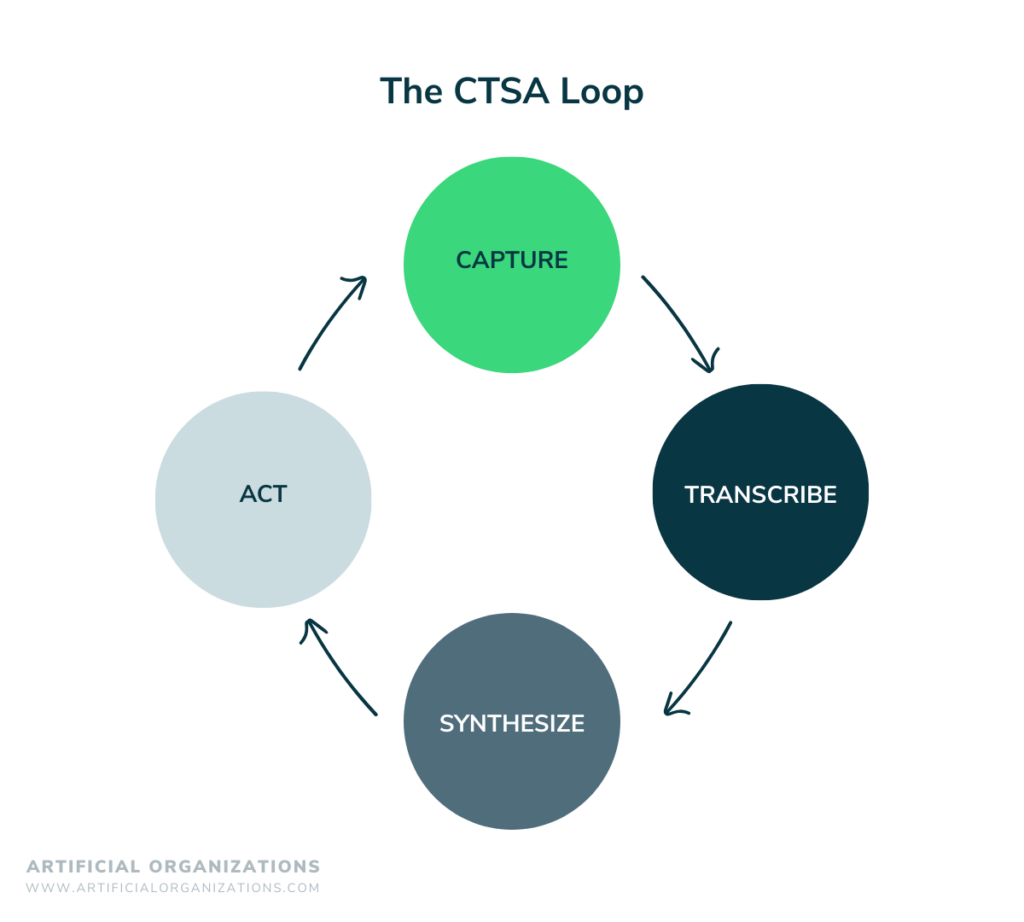
Capture → Transcribe → Synthesize → Act
Each step strengthens the next, creating a compounding loop.
Instead of constantly reconstructing context, leaders move through decisions with clarity and momentum.
Over time this becomes the operating rhythm of an Artificial Organization, which we define as, companies that deliberately combine human judgment with machine intelligence to redesign how decisions are made, how knowledge flows, and how work improves over time.
Capture: Recording Organizational Intelligence
The first step is capturing information automatically.
Most organizations lose enormous amounts of valuable insight every day. Important discussions happen in meetings. Decisions are debated in Slack threads. Ideas emerge in hallway conversations or voice notes. Yet very little of this information is structured or preserved.
AI changes this.
Meeting transcripts, call recordings, notes, and conversations can now be captured automatically. Instead of relying on memory or fragmented notes, leaders begin with a reliable record of what actually happened. This captured information becomes the raw material for organizational intelligence.
In many companies, simply implementing automated capture reveals how much valuable context was previously disappearing. Leaders stop asking, “What was decided last week?” or “Who said what?” because the system already knows.
Transcribe: Turning Information Into Usable Intelligence
Once information is captured, the next step is transcription. This is where AI begins transforming raw conversations into usable organizational intelligence.
Meetings, calls, voice notes, and discussions contain enormous amounts of valuable information, but historically much of that insight disappears the moment the conversation ends. Notes are partial, memories are imperfect, and context gets lost.
AI changes this dynamic by transcribing conversations automatically and accurately, creating a reliable record of what was actually said.
Instead of relying on fragmented notes or recollection, leaders now have a searchable record of discussions across meetings, calls, and collaborative conversations.
This is where AI becomes a powerful thinking partner.
Once conversations are transcribed, leaders can interrogate the material through questions.
- What themes are emerging?
- What risks were mentioned?
- What unresolved issues remain?
- Where do opinions diverge?
AI allows leaders to explore these transcripts quickly and deeply.
Instead of scanning hundreds of messages or notes manually, they can surface the underlying signal within minutes. Important context that once required hours of reconstruction can now be accessed instantly.
This dramatically accelerates how leaders develop situational awareness.
It is also one of the first places where decision velocity begins to increase. Leaders arrive at discussions with a clearer understanding of what has happened, what issues remain open, and what decisions are required next.
Synthesize: Clarifying the Decision
Once insights emerge, they must be synthesized.
Most leadership decisions fail not because the analysis was wrong but because the issue was never framed clearly.
- What exactly are we deciding?
- What are the options?
- What assumptions are we making?
- What trade-offs exist?
AI excels at synthesis. It can transform messy conversations and scattered information into structured decision briefs.
These briefs often include:
- a summary of the issue
- key insights and context
- possible options
- risks and constraints
- recommended next steps
When teams arrive at meetings with this level of preparation, the conversation changes. Instead of reconstructing context, leaders focus on judgment. This is where decision advantage begins to emerge.
Act: Accelerating Execution
The final stage is action.
Once a decision is made, execution often slows down again. Tasks must be assigned. Communication must be written. Updates must be shared.
AI can streamline much of this work.
- Decision summaries can be generated automatically.
- Follow-up actions can be captured and distributed.
- Communication to stakeholders can be drafted in minutes.
This allows teams to move from decision to implementation faster. Over time, organizations that operate this way develop a rhythm where decisions translate into action quickly and consistently.
A Case Example: Turning Meetings Into Decision Moments
Research from McKinsey shows executives spend nearly 40% of their time making decisions. Yet more than half say much of that time is spent inefficiently gathering information, aligning stakeholders, and reconstructing context before important decisions can be made.
One executive featured in Artificial Organizations began experimenting with the CTSA workflow across her leadership meetings.
Before implementing the system, meetings often followed a familiar pattern.
Leaders would spend the first half of the meeting reconstructing what had happened since the previous one. Updates were shared verbally, context had to be rebuilt, and decisions were frequently postponed because information was incomplete.
After implementing the CTSA approach, the workflow changed dramatically.
First, all leadership meetings were automatically recorded and transcribed.
Next, AI was used to extract key themes, open questions, and decision points from those conversations.
These insights were synthesized into short briefing documents before the next meeting. By the time the team gathered again, everyone already understood the context and the decision required. Meetings became dramatically shorter, discussions became sharper and decisions happened earlier.
The executive described the shift as moving from meetings about work to meetings for decisions.
The Research Behind Decision Speed
Research increasingly highlights the importance of decision speed in modern organizations.
In our Artificial Organizations AI Executive Study (2025), we saw leaders who integrated AI into decision preparation reported 30–50% faster decision cycles and significantly reduced time spent gathering information and preparing for meetings. Organizations adopting these AI-augmented workflows consistently reported clearer decisions and faster execution.
Faster decisions allow organizations to respond to market changes sooner, allocate resources more effectively, and learn from feedback cycles faster.
However, speed alone is not enough. Fast decisions without clarity lead to mistakes. The real advantage comes when organizations combine decision velocity with decision advantage.
AI-supported workflows like the CTSA Model allow leaders to improve both simultaneously. By removing friction from information capture, analysis, and synthesis, leaders can focus their attention where it matters most. Judgment.
Building the Decision Infrastructure
The most important shift leaders make when adopting the CTSA Model is recognizing that AI is not just another productivity tool, it is judgment infrastructure.
Organizations have long invested in systems that manage finance, operations, and logistics. Now leaders must build systems that support how the organization thinks.
- Capture ensures important information is never lost.
- Transcribe accelerates insight discovery.
- Synthesis clarifies decisions.
- Action translates judgment into execution.
Together, these stages form the backbone of an Artificial Organization.
The Compounding Effect
When the CTSA Model becomes embedded into leadership workflows, the benefits compound.
- Leaders spend less time reconstructing context.
- Teams arrive at meetings prepared.
- Decisions happen earlier in the conversation.
- Execution begins faster.
Over time, this creates a structural advantage. Organizations begin to move through problems more quickly than competitors. They recognize patterns earlier. They respond to opportunities sooner, and they learn faster.
The Leadership Question
Most leaders today are experimenting with AI tools. Some are writing emails faster. Others are generating research summaries or presentations. These are useful improvements but they are not where the real advantage lies.
The real advantage comes when leaders redesign how decisions move through the organization.
The CTSA Model offers a simple starting point.
- Capture what matters.
- Transcribe information to reuse and leverage.
- Synthesize decisions.
- Act quickly.
Leaders who build these workflows will not simply use AI more efficiently. They will build organizations that think and decide better.
And in the coming decade, that may become the most important competitive advantage of all.
FAQ
Q1. What is the CTSA model?
The CTSA model is a framework that helps leaders use AI to improve decision-making by capturing, transcribing, synthesizing, and acting on information.
Q2. How does the CTSA model improve decision-making?
It reduces time spent gathering and reconstructing information, allowing leaders to focus on interpreting insights and making decisions faster.
Q3. What does CTSA stand for?
CTSA stands for Capture, Transcribe, Synthesize, and Act.
Q4. Why is decision-making slow in organizations today?
Decision-making is slow because leaders spend too much time collecting information, aligning context, and preparing for decisions instead of making them.
Q5. How does AI support the CTSA model?
AI captures conversations, transcribes discussions, synthesizes insights, and helps execute decisions, reducing friction across the entire workflow.
Q6. What is decision velocity and why does it matter?
Decision velocity is how quickly an organization moves from insight to action. Faster decision cycles allow companies to respond, learn, and adapt more effectively.
Q7. What is the biggest mistake leaders make with AI?
The biggest mistake is using AI only for productivity tasks instead of redesigning how decisions move through the organization.