
Most leaders experimenting with AI start in the wrong place. They start with productivity.
They ask AI to write emails, summarize documents, or generate presentations. These capabilities are impressive and useful, but they only scratch the surface of what AI can do for leadership.
The real opportunity is not productivity, it is thinking.
The leaders gaining the greatest advantage from AI are not using it primarily to execute tasks faster. They are using it as a thinking partner to sharpen judgment, pressure-test ideas, and prepare better decisions.
This shift is subtle, but its impact is profound. When AI becomes part of a leader’s thinking process, it begins to influence how decisions are formed, how problems are framed, and how organizations move from insight to action.
The Hidden Bottleneck in Leadership
Leadership has always been a thinking profession.
Executives are paid not to produce documents or process information, but to exercise judgment under uncertainty. Yet much of a leader’s time is consumed by work surrounding decisions rather than the decisions themselves.
Research consistently shows that executives spend enormous amounts of time preparing for decisions: gathering information, summarizing conversations, and reconstructing context before meetings.
In the Artificial Organizations AI Executive Study (2025), leaders reported spending between 30–40% of their week preparing for meetings, gathering information, and synthesizing context before key decisions. This reflects broader industry research from HBR showing senior executives spend more than 23 hours per week in meetings, with additional hours spent preparing for them.
This preparation work is necessary, but it creates friction. When leaders spend hours assembling context, they have less time for the work that matters most: interpreting signals, exploring alternatives, and making confident decisions. This is where AI changes the equation.
The Shift from Tool to Thinking Partner
Most people use AI like a tool. They give it a prompt and expect an answer.
Leaders who unlock its real power use it differently. They use AI to interrogate their thinking.
Instead of asking AI to produce finished output, they engage it in a dialogue that helps refine their judgment. They explore questions such as:
- What assumptions am I making here?
- What alternative interpretations exist?
- What risks might I be overlooking?
- How would a skeptical stakeholder challenge this idea?
This process transforms AI from a generator of content into a partner in reasoning. Rather than replacing human judgment, AI amplifies it.
The Executive Preparation Advantage
One of the most powerful applications of AI as a thinking partner appears in executive preparation.
Consider how leaders traditionally prepare for a major meeting. They review documents, scan reports, read previous notes, and try to reconstruct what happened in earlier discussions. This process is slow and often incomplete.
With AI integrated into leadership workflows, preparation changes dramatically. Captured meeting transcripts, written updates, and research materials can be analyzed by AI to produce structured summaries of key issues. Leaders can then explore these summaries interactively.
- What decisions are pending?
- Where do opinions diverge?
- What information is still missing?
This approach dramatically accelerates preparation time while increasing clarity.
In the Artificial Organizations AI Executive Study (2025), leaders using AI-assisted preparation reported 30–50% faster decision cycles and significant reductions in time spent gathering information before meetings.
The benefit is not simply time saved, it is better thinking under pressure.
A Case Study: Preparing for the Executive Room
One executive featured in Artificial Organizations began experimenting with AI as a thinking partner while preparing for leadership meetings.
Previously, preparing for these sessions required several hours of work. The executive would review documents, read through email threads, and attempt to reconstruct the key issues discussed in earlier meetings before the next discussion began.
After integrating AI into the preparation workflow, the process changed.
Meeting conversations were automatically captured and transcribed. AI tools were then used to summarize prior discussions, highlight unresolved issues, and surface key themes that had emerged across conversations. Instead of manually reviewing multiple sources of information, the executive could quickly explore a structured overview of the situation.
Preparation time dropped from several hours to roughly ninety minutes.
But the most meaningful change appeared in the meeting itself. Instead of spending the early part of discussions reconstructing context, the executive arrived with a clearer understanding of the issues, the assumptions being made, and the possible decision paths ahead.
As a result, discussions moved more quickly to the substance of the decision. Questions became more focused, and the group was able to spend more time evaluating trade-offs rather than reviewing background information.
The executive later reflected that the biggest difference was not the time saved in preparation, but the quality of thinking it enabled: “I arrived prepared in a way that wasn’t possible before.”
Pressure-Testing Decisions Before They Happen
Another powerful application of AI as a thinking partner is decision rehearsal.
Leaders frequently enter high-stakes conversations where clarity, judgment, and executive presence matter—board meetings, investor discussions, and strategic reviews.
In these situations, the quality of preparation often determines the quality of the outcome.
To explore this further, we introduced a simple experiment with the same executive, the CEO-bot: an AI system designed to act as a challenging counterpart during preparation.
The system was configured to question assumptions, raise alternative interpretations, and surface potential counterarguments while the executive prepared for upcoming conversations with the CEO and board.
In practice, this meant the executive could test their thinking before entering the room. If a strategy had weaknesses, the system would highlight them. If a proposal lacked supporting evidence, it would prompt further exploration. If a line of reasoning was unclear, the executive could refine it in advance.
This process is not entirely new. Many experienced leaders already pressure-test ideas with trusted colleagues or advisors.
The difference with AI is speed and accessibility.
Instead of waiting for the next conversation with a peer or mentor, leaders can explore multiple perspectives immediately, refining their thinking in real time.
The result was noticeable. The executive entered discussions with clearer framing, stronger reasoning, and greater confidence in the arguments they presented. Colleagues began to comment on the clarity of preparation and the quality of contributions in leadership meetings.
Over time, this kind of preparation does more than improve individual performance. It strengthens the overall decision process of the organization.
Leaders arrive with clearer thinking. Conversations move more quickly to the real issues. And decisions happen earlier and with greater confidence.
The Research on Decision Quality
Research increasingly shows that organizations that make high-quality decisions quickly outperform competitors. Bain & Company’s work on decision effectiveness found that companies that excel at decision-making outperform peers financially by up to 95 percent.
Yet most organizations struggle to improve decision quality because the process surrounding decisions is slow and fragmented. Information is scattered. Context must be reconstructed. Perspectives are incomplete. AI reduces this friction.
When leaders have access to synthesized context and can explore issues interactively, they move more confidently from signal to judgment. This is where decision velocity and decision advantage begin to compound.
Thinking Systems, Not Thinking Alone
One of the most important insights from the Artificial Organizations work is that leadership is rarely an individual activity. Leaders operate inside systems. Information flows through those systems. Decisions move through those systems. Knowledge accumulates within those systems. AI allows organizations to design systems that support thinking itself.
Captured conversations feed into AI analysis. Insights are synthesized into decision briefs. Leaders explore those briefs with AI before making decisions. Over time this creates a feedback loop. The organization becomes progressively better at understanding its own information. Leadership thinking becomes more structured, more informed, and more consistent.
The shift to AI as a thinking partner does not require a massive transformation. It begins with small habits. Leaders begin capturing their meetings and conversations. They explore those transcripts using AI. They ask AI to challenge assumptions before making decisions. They use AI to clarify issues before entering important discussions.
Over time these habits reshape how leaders think. Preparation becomes faster, clarity increases and decisions accelerate.
The Competitive Advantage of Thinking Faster
In the coming decade, organizations will not compete primarily on who has access to AI tools. Those tools are rapidly becoming available to everyone. The real competitive advantage will come from how leaders integrate AI into their thinking processes.
Leaders who treat AI as a productivity assistant will see incremental gains. Leaders who treat AI as a thinking partner will experience something very different. Their preparation improves. Their reasoning sharpens. Their organizations move from information to decision faster than competitors.
We see this consistently in the leaders we work with through the Artificial Organizations programs and executive coaching. Once leaders begin using AI as a thinking partner in their leadership workflows, the impact becomes measurable. Executive preparation time drops significantly. Meeting context is reconstructed in minutes instead of hours. Leaders report clearer framing of strategic issues and greater confidence in the decisions they bring to their teams.
In the Artificial Organizations AI Executive Study (2025), leaders experimenting with AI-augmented decision workflows reported 30–50% faster decision cycles, along with meaningful reductions in time spent preparing for meetings, summarizing conversations, and gathering context before making decisions. Several executives also reported a noticeable shift in the quality of their leadership conversations. With less time spent reconstructing information, discussions focused more quickly on judgment, trade-offs, and action.
Over time this difference compounds. Decision velocity increases, decision advantage strengthens, and leadership itself evolves.
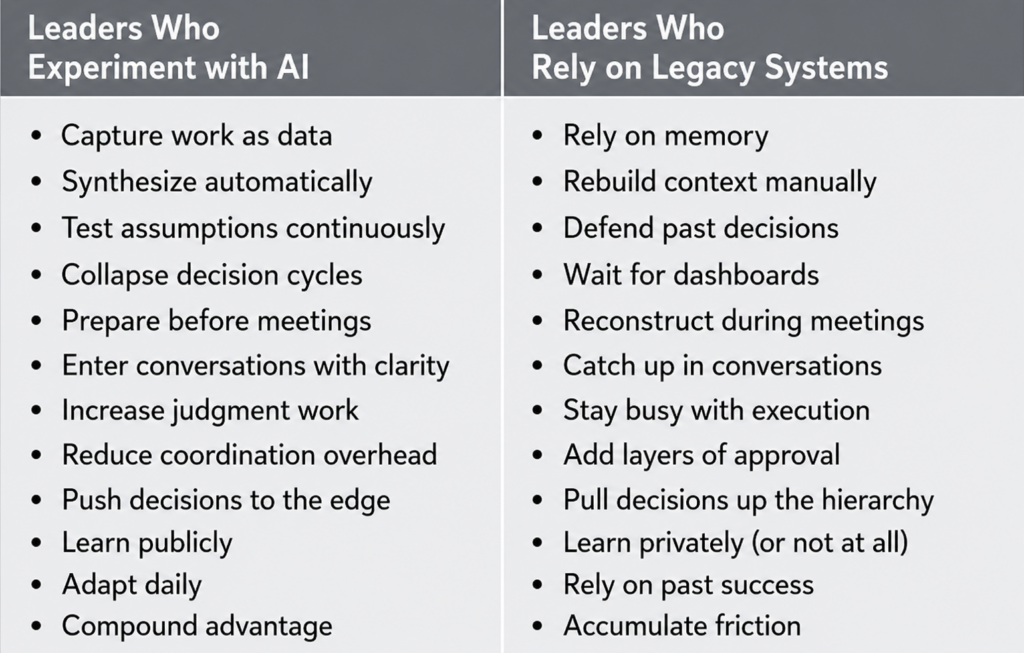
Organizations that redesign how leaders think with AI are not simply becoming more efficient. They are building a structural advantage in how quickly they interpret signals, explore options, and act with confidence.
And in environments defined by uncertainty and rapid change, thinking faster and deciding better may become the most important competitive advantage of all.
The Leadership Question for You
AI will not replace leaders. But it will change how leadership works.
The most effective leaders of the next decade will not simply manage people and resources. They will design systems that amplify thinking.
The question leaders must now ask themselves is simple. Are you using AI to produce more content? Or are you using it to think better?
Because the leaders who build AI into their thinking processes will not simply work faster.
They will make better decisions, faster than everyone else in the room.
FAQs
Q1. What does it mean to use AI as a thinking partner?
Using AI as a thinking partner means engaging it to refine ideas, challenge assumptions, and improve decision-making rather than just generating outputs.
Q2. How is AI as a thinking partner different from using AI for productivity?
Productivity use focuses on tasks like writing or summarizing. A thinking partner approach focuses on improving judgment, preparation, and decision quality.
Q3. Why is decision-making still slow in organizations today?
Leaders spend a significant amount of time gathering information, reconstructing context, and preparing for meetings instead of focusing on decisions themselves.
Q4. How does AI improve executive preparation?
AI analyzes transcripts, documents, and data to create structured summaries, helping leaders prepare faster and with greater clarity before decisions.
Q5. How can leaders use AI to improve decision quality?
Leaders can use AI to pressure-test ideas, explore alternative perspectives, and identify risks before entering high-stakes discussions.
Q6. What is the competitive advantage of using AI as a thinking partner?
Leaders who integrate AI into their thinking processes improve decision speed and clarity, creating a structural advantage in how organizations operate.
References
Artificial intelligence is evolving faster than any technology wave most organizations have experienced.
New tools appear every week, capabilities change every month, and most leaders quickly find themselves asking the same question: What tools should we actually use?
At Artificial Organizations, we work with executives, founders, and leadership teams who are redesigning how their organizations operate in the age of AI.
Through our accelerator programs, coaching engagements, and research, we see hundreds of AI workflows being tested inside real organizations.
Some tools create real leverage, others create noise.
This page captures the tools we consistently see delivering the most value for leaders and teams today.
Think of it as a living AI stack for building Artificial Organizations. We update it regularly as the ecosystem evolves.
How to Think About Your AI Stack
One of the biggest mistakes organizations make is starting with tools. In Artificial Organizations, we introduce the 3T model, a simple sequence for adopting AI effectively:
Traits → Tasks → Tools
First, understand how you and your team think and work best. Then identify the high-leverage tasks where better thinking and decision-making create disproportionate value. Only then should you select the tools that support those workflows.
The tools below are organized around the core capabilities leaders need to build AI-augmented operating systems, and build better judgment, speed and results with human AND machine intelligence.
Interested in a specific section — jump to it
The Artificial Organizations Recommended AI Stack
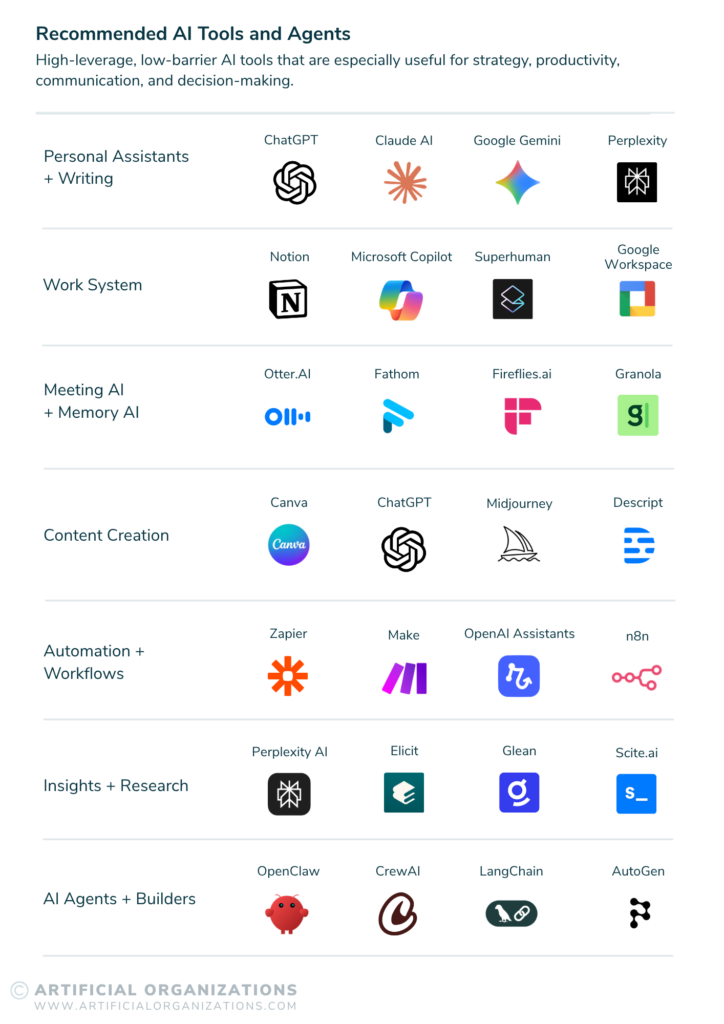
1. Personal Assistants + Writing AI
These tools act as thinking partners for leaders, helping synthesize ideas, draft communication, and pressure-test decisions.
ChatGPT

One of the most versatile AI assistants available. ChatGPT is widely used for writing, idea generation, synthesis, and reasoning support.
Pros
- Strong reasoning and synthesis capabilities
- Flexible across many workflows
- Large ecosystem of integrations and agents
Cons
- Requires good prompting discipline
- Context windows can limit extremely long conversations
Claude AI

Claude is known for its thoughtful reasoning and long-context capabilities, making it particularly useful for working with long documents.
Pros
- Excellent long-form analysis
- Strong reasoning style for strategy and writing
- Reliable for document interpretation
Cons
- Slightly fewer integrations than some competitors
- Slower response times for complex queries
Google Gemini

Gemini integrates deeply with Google’s ecosystem and is particularly useful for teams using Google Workspace.
Pros
- Native integration with Google Docs, Gmail, and Sheets
- Fast responses
- Good multimodal capabilities
Cons
- Reasoning quality can vary across tasks
- Less consistent for deep strategy work
Perplexity AI

Perplexity is a powerful AI search and research tool designed to provide real-time information with citations.
Pros
- Excellent research capability
- Real-time web data
- Strong citation transparency
Cons
- Less useful for writing and creative ideation
- Dependent on external data sources
2. Work Systems
AI becomes dramatically more powerful when embedded inside a work system where knowledge accumulates.
These platforms allow teams to capture thinking, organize work, and maintain institutional memory.
Notion

A flexible workspace combining documentation, databases, and AI-assisted knowledge management.
Pros
- Powerful knowledge management
- Flexible workflows
- Increasing AI integration
Cons
- Requires thoughtful structure to avoid complexity
- Can become cluttered if not maintained
Microsoft Copilot

Microsoft’s AI layer embedded across Office, Teams, and enterprise workflows.
Pros
- Deep integration with enterprise tools
- Strong productivity automation
- Secure enterprise architecture
Cons
- Works best within the Microsoft ecosystem
- Limited flexibility outside that environment
Superhuman

An AI-enhanced email platform designed to help professionals manage high communication volume.
Pros
- Excellent speed and productivity features
- AI-assisted writing and summarization
- Strong user experience
Cons
- Premium pricing
- Primarily focused on email workflows
Google Workspace

A widely used productivity ecosystem now integrating AI across its products.
Pros
- Familiar environment for many teams
- Strong collaboration capabilities
- Increasing AI support
Cons
- AI capabilities still evolving
- Limited customization compared to specialized tools
3. Meeting AI + Organizational Memory
Meetings are where most organizational decisions begin.
AI meeting tools capture conversations and convert them into structured knowledge.
This capability forms the foundation of the Capture → Transcribe → Synthesize → Act workflow described in Artificial Organizations.
Otter.ai

A widely used meeting transcription platform for capturing conversations.
Pros
- Reliable transcription
- Easy meeting summaries
- Strong integrations
Cons
- Limited deeper synthesis capabilities
- Requires manual review for best results
Fathom

A meeting assistant that automatically captures key moments and summaries.
Pros
- Simple setup
- Strong highlights and summaries
- Excellent for Zoom users
Cons
- Limited deeper analysis features
Fireflies.ai

A meeting intelligence platform designed for team collaboration.
Pros
- Good integrations across meeting platforms
- Searchable transcripts
- Collaboration features
Cons
- Interface can feel complex for new users
Granola

A newer tool focused on turning meeting notes into structured insights.
Pros
- Clean user experience
- Strong knowledge synthesis
Cons
- Still evolving as a platform
4. Content Creation Tools
AI dramatically accelerates the creation of visual, written, and multimedia content.
These tools help leaders communicate ideas quickly and clearly.
Canva

A powerful design platform with integrated AI for visual creation.
Pros
- Extremely easy to use
- Strong template ecosystem
- Fast content production
Cons
- Limited customization for advanced design needs
Midjourney

A leading AI image generation tool known for high-quality visuals.
Pros
- Exceptional image quality
- Powerful creative possibilities
Cons
- Requires prompt experimentation
- Limited traditional UI
Descript

A platform for editing audio and video through text-based workflows.
Pros
- Simple podcast and video editing
- AI voice and transcription features
Cons
- Best suited for content workflows
5. Automation + Workflow AI
Automation tools allow organizations to connect systems and create AI-powered workflows.
Zapier

One of the most widely used automation platforms.
Pros
- Massive integration ecosystem
- Easy automation setup
Cons
- Can become expensive at scale
Make

A powerful visual automation platform for complex workflows.
Pros
- Advanced automation capabilities
- Highly customizable
Cons
- Learning curve for beginners
N8n
An open-source automation platform increasingly used by AI builders.
Pros
- Highly flexible
- Strong for complex workflows
Cons
- Requires more technical setup
OpenAI Assistants
Tools for building custom AI agents and workflows.
Pros
- Highly customizable
- Enables AI-native systems
Cons
- Requires development resources
6. Insights + Research
These tools help leaders quickly explore research, insights, and complex information.
Perplexity AI

One of the fastest ways to explore real-time information.
Pros
- Reliable citations
- Fast research
Cons
- Less suited for creative ideation
Elicit
An AI research assistant designed for analyzing academic papers.
Pros
- Strong research synthesis
- Useful for deep knowledge exploration
Cons
- Narrower use cases
Glean
An enterprise knowledge search tool for internal information.
Pros
- Powerful enterprise search
- Cross-system knowledge discovery
Cons
- Enterprise-focused implementation
Scite.ai
A research tool that analyzes how academic papers cite one another.
Pros
- Excellent research validation
- Useful for evidence-based work
Cons
- Specialized research audience
AI Agent Builders
These tools allow organizations to build AI-native workflows and autonomous agents.
- OpenClaw
- CrewAI
- LangChain
- AutoGen
These platforms enable teams to design multi-agent AI systems that can execute complex tasks.
They are typically used by:
- AI engineering teams
- product teams
- AI-native startups
Barry O’Reilly’s Personal AI Stack
While the ecosystem evolves quickly, Barry’s personal stack focuses on a small number of tools used deeply.
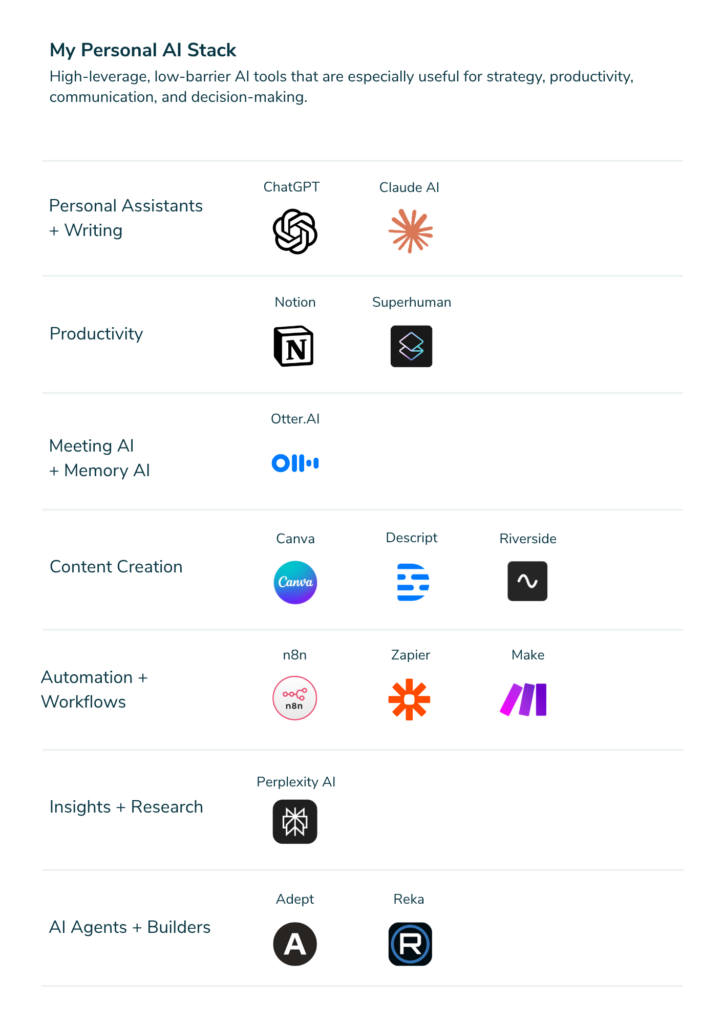
Personal Assistants
- ChatGPT
- Claude
Productivity
- Notion
- Superhuman
Meeting AI
- Otter.ai
Content Creation
- Canva
- Descript
- Riverside
Automation
- N8n
- Zapier
- Make
Research
- Perplexity AI
AI Builders
- Adept
- Reka
The goal is not to use more tools. It is to build workflows where AI amplifies thinking and decision-making.
The Stack Test
Many organizations accumulate AI tools without gaining real advantage. If you want to evaluate your own stack, ask three questions:
1. Does this tool accelerate decision-making?
If it doesn’t improve how quickly and clearly your team makes decisions, it’s probably noise.
2. Does it capture knowledge that would otherwise disappear?
The most valuable AI tools create organizational memory.
3. Does it compound over time?
Great AI workflows improve continuously. Weak ones stay static.If your AI stack passes these three tests, you’re likely building the foundations of an Artificial Organization.
Remember, experiments entertain curiosity. Stacks boost performance.
Build Your Artificial Organization
The tools on this page are only the beginning. Real advantage comes from how they are used together to create systems where:
- knowledge compounds
- decisions accelerate
- organizations learn faster
That is the core idea behind Artificial Organizations, and it is the work we help leaders build every day.
FAQ
Q1. What is an AI stack for leaders?
An AI stack for leaders is a set of tools and workflows that improve how leaders think, make decisions, and manage work using AI.
Q2. How should leaders choose AI tools?
Leaders should start with how they think and work, then identify high-leverage tasks, and only then choose tools that support those workflows.
Q3. What is the biggest mistake when building an AI stack?
The biggest mistake is starting with tools. Without clear workflows and decision needs, tools create noise instead of real performance gains.
Q4. What tools are essential in an AI stack?
Most effective stacks include AI assistants, meeting capture tools, work systems, research tools, and automation platforms that support decision-making.
Q5. How does an AI stack improve decision-making?
An AI stack improves decision-making by capturing information, synthesizing insights, and reducing the time needed to prepare and act on decisions.
Q6. What makes an AI stack effective?
An effective AI stack accelerates decisions, captures knowledge that would otherwise be lost, and improves continuously over time.
Q7. Do leaders need many AI tools to build an effective stack?
No. The best leaders use a small number of tools deeply. The goal is not more tools, but better workflows that improve thinking and results.
References
Why the companies that redesign how they think with AI will outperform those that simply adopt tools
Most companies think the AI race is about tools. It isn’t. The real race is about how leaders and organizations think.
Every major technological shift forces us to reinvent how we operate.
The industrial era created the hierarchical organization. The software era created Agile organizations. The AI era will create something different again. Not companies that simply use AI tools, but companies that think, learn, and operate with AI as part of their core system.
These are Artificial Organizations, companies that deliberately combine human judgment with machine intelligence to redesign how decisions are made, how knowledge flows, and how work improves over time.
The result is an organization that moves faster, decides more clearly, and compounds advantage continuously.
The Problem Most Organizations Face
Today, leaders everywhere are experimenting with AI. New copilots, new assistants and new dashboards appear almost weekly.
Too many organizations approach AI the same way they approached previous technologies. They try to bolt it onto existing ways of working. This rarely produces real transformation.
Instead it creates:
- tool overload
- fragmented workflows
- scattered experiments
- little compounding advantage
The result is activity without transformation.
Research reflects the same pattern. In one major MIT study, roughly 95% of enterprise GenAI initiatives fail to deliver measurable business value, with only about 5% scaling into production impact.
The issue isn’t the technology. It’s the system leaders are trying to plug it into.
Organizations designed for the pre-AI era struggle to absorb AI in meaningful ways. They layer tools on top of outdated workflows instead of redesigning how work actually happens. The organizations that succeed will do the opposite.
The Real Shift Is Not Technology
The real shift happening with AI is leadership behavior. AI changes the economics of knowledge work.
For the first time:
- information can be captured automatically
- thinking can be synthesized instantly
- communication can be generated at scale
- workflows can be continuously improved by machines
When this capability becomes embedded into how leaders and their organizations operate, something powerful happens. Work begins to compound.
Small improvements in thinking, communication, and decision-making accumulate into structural advantage. The companies that understand this shift are not treating AI as software. They are redesigning how judgment works inside the organization.
As I wrote in Artificial Organizations, the real opportunity is not automation. It is judgment infrastructure—systems that allow leaders to sense, think, decide, and act faster without sacrificing clarity.
Organizations that build this capability develop something incredibly powerful: decision velocity and decision advantage.
From Tool Adoption to System Design
Most organizations today focus on AI tool adoption. Artificial Organizations focus on AI system design.
Instead of asking: “What tools should we use?”
They ask: “How should the organization work when intelligence is abundant?”
This leads to a different approach.
Leaders redesign:
- how thinking happens
- how knowledge flows
- how decisions are prepared
- how communication scales
- how workflows improve over time
AI becomes the infrastructure that enables these systems. It moves from being an experiment at the edge of the business to becoming a core capability that accelerates how organizations think and learn.
The Era of the Artificial Organization
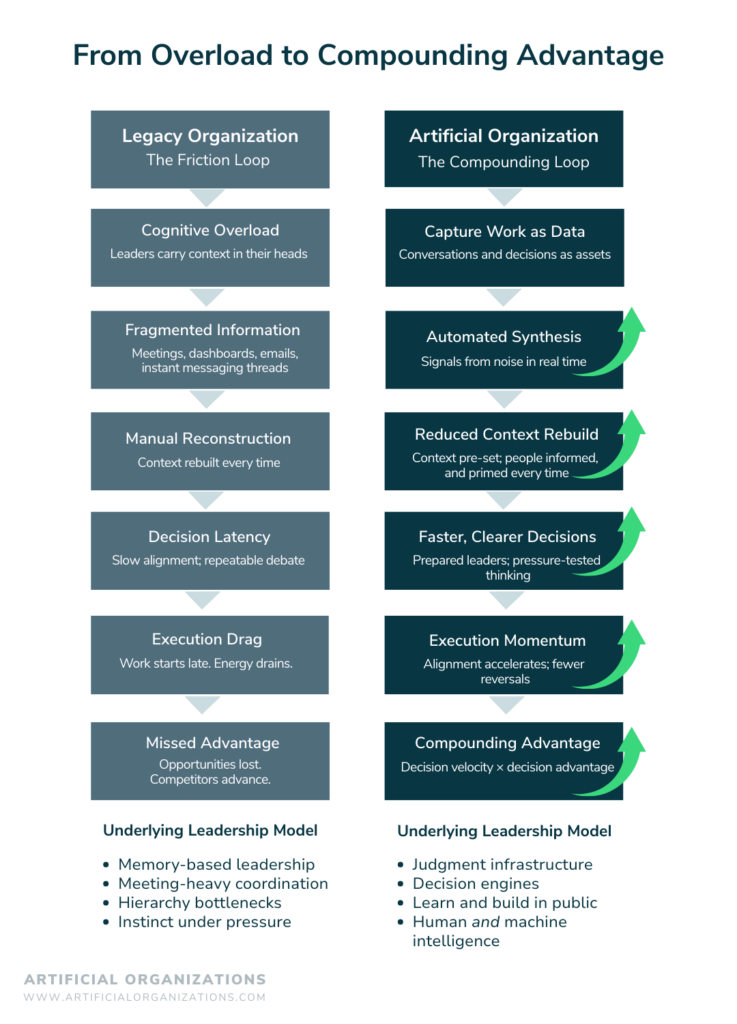
An Artificial Organization is a company that deliberately designs compounding loops between people and AI. These loops continuously improve how work gets done.
For example:
- Conversations are captured.
- Insights are synthesized.
- Decisions are clarified.
- Knowledge accumulates.
- Workflows improve.
Each cycle strengthens the next.
Over time the organization begins to learn faster than its competitors. That is the true advantage of AI.
Not automation. Organizational intelligence.
Human and machine intelligence compounding inside the organization.
The Leadership Shift
Artificial Organizations require a new type of leadership. In the past, leaders focused primarily on:
- Strategy
- Culture
- Structure
In the AI era, leaders must also design how you and your organization think.
This means redesigning the workflows where judgment, communication, and knowledge creation happen.
It begins with you, as an individual leader. If leaders do not redesign how they personally work with AI, attempts to scale AI across teams will fail.
Technology adoption alone does not transform organizations. Leadership behavior does. When leaders redesign their workflows, teams follow. When teams redesign workflows, organizations evolve.
How to Lead an Artificial Organization
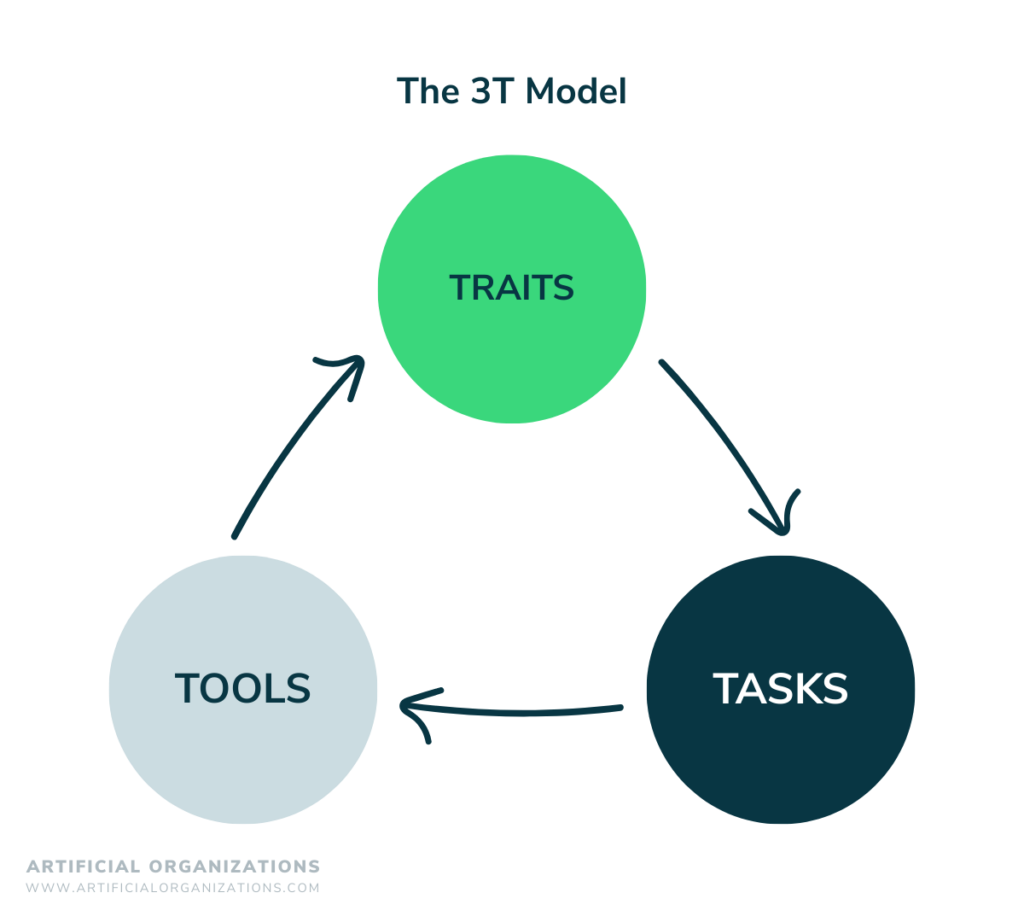
In Artificial Organizations I introduce the 3T Model for leading in the age of AI:
Traits → Tasks → Tools
Artificial Organizations are not built with tools first. They are built by redesigning leadership workflows.
Most leaders start with tools. That is the mistake. Tools are the last step, not the first, and the order matters.
Traits
Start with how you naturally think and work.
Your traits determine how you create, process, and use information.
Some leaders think best when speaking. Others when writing, mapping ideas, or reviewing structured analysis. When AI aligns with these natural thinking patterns, thinking accelerates.
Tasks
Next identify the tasks where your judgment creates the most leverage.
These include:
- strategic thinking
- Synthesis
- Coaching
- Decisions
- Problem framing
AI should automate low-leverage administrative work so leaders can focus on high-leverage judgment.
Preparation, summarization, documentation and follow-up can increasingly be handled by AI. That frees leaders to focus on the work that matters most.
Tools
Only then should you choose tools.
When tools align with traits and tasks, they become multipliers rather than distractions.
As the book puts it: “Start with traits. Follow with tasks. Then choose tools.”
Over time these workflows become systems.
And those systems become the foundation of an Artificial Organization.
The Compounding Advantage
Leaders that adopt this model gain something powerful: decision velocity and decision advantage.
They:
- capture more knowledge
- synthesize insights faster
- make decisions with greater clarity
- communicate more effectively
- improve workflows continuously
The result is faster decision cycles, better informed choices and stronger execution.
Leaders using our AI-augmented judgment systems have reported 30–50% faster decision cycles and significant reductions in preparation, follow-up and implementation time. Also captured in case studies with American Airlines, Skyscanner and Slack to name a few in the book.
Small improvements compound, and the organization becomes progressively more intelligent.
The New Competitive Frontier
In the coming decade, companies will not compete primarily on:
- Strategy
- Capital
- Technology access
Those advantages are becoming increasingly democratized. Instead they will compete on how effectively their organizations think and learn with AI.
The companies that figure this out first will not just move faster. They will operate with fundamentally different economics. Decisions will be prepared faster. Knowledge will accumulate automatically. Leaders will spend more time exercising judgment and less time gathering information.
Over time this creates something every executive understands instinctively: a widening decision advantage.
Many companies already recognize the urgency. McKinsey reports that 88% of organizations now consider AI transformation a top priority.
But adoption alone does not create advantage. Leadership behavior does. Some companies will remain traditional organizations that use AI tools. Others will become Artificial Organizations.
The gap between the two will widen steadily—and then suddenly.
The Movement
Artificial Organizations is not just a framework. It is a movement to help leaders redesign how their companies work in the age of AI.
The book introduces the model.
The accelerator helps leaders implement it.
And our community becomes a place where the next generation of organizations is being built.
The Opportunity
The leaders who understand this shift early will not simply adopt AI faster. They will design organizations that become progressively smarter over time.
Organizations where knowledge compounds, decisions accelerate and judgment improves.
Some companies will remain traditional organizations that use AI tools. Others will become Artificial Organizations.
The difference between the two will define the next generation of market leaders—and we are only just beginning.
The real question for leaders now is simple: are you experimenting with AI tools, or redesigning how you and your organization thinks?
FAQ
Q1. What is an Artificial Organization?
An Artificial Organization combines human judgment and AI systems to redesign how decisions are made, how knowledge flows, and how work improves over time.
Q2. How are Artificial Organizations different from companies using AI tools?
Most companies add AI tools to existing workflows. Artificial Organizations redesign how work happens, using AI as a core system for thinking, decision-making, and learning.
Q3. Why do most AI initiatives fail in organizations?
Most fail because companies layer AI onto outdated systems. Without redesigning workflows and decision processes, AI creates activity but not real transformation.
Q4. What is decision velocity in an Artificial Organization?
Decision velocity is the speed at which organizations move from signal to judgment. Artificial Organizations increase this by capturing, synthesizing, and acting on information faster.
Q5. How can leaders start building an Artificial Organization?
Leaders start by redesigning how they personally work with AI. They align their thinking (traits), focus on high-leverage tasks, and then choose tools that support those workflows.
References
- Massachusetts Institute of Technology (MIT). State of AI in Business 2025 Report.
- McKinsey & Company. The State of AI.
- O’Reilly, B. Artificial Organizations.
Most leaders think AI will automate work. The real change is more uncomfortable. AI is beginning to expose how leaders actually think.
For the past two years, a question has dominated conversations about artificial intelligence: Will AI replace leaders?
The short answer is no.
AI will not replace leadership but it will replace leaders who refuse to evolve how they work.
Leadership has never been about executing tasks. It has always been about exercising judgment under uncertainty. Leaders interpret signals, evaluate trade-offs, and make decisions when the answer is not obvious.
AI cannot replace that but it is fundamentally changing how that work happens.
The leaders who learn to integrate AI into their thinking will gain a structural advantage over those who do not.
The Hidden Bottleneck in Leadership
Leadership has always been a thinking profession.
Executives are not paid to produce documents or process information. They are paid to exercise judgment. Yet most leaders spend the majority of their week doing work that surrounds decisions rather than making them.
Harvard Business Review reports that senior executives spend more than 23 hours per week in meetings, with additional hours spent preparing for them. In our Artificial Organizations AI Executive Study (2025), we asked leaders to map how they actually spend their time and a striking pattern emerged. Roughly 80% of leadership time is consumed by:
- meetings
- updates
- coordination
- administration
- reconstructing context
Yet 80% of leadership value comes from:
- framing the right problems
- evaluating trade-offs
- being fully present in critical decisions
- making high-quality judgments
This isn’t a time management problem. It’s a decision allocation problem.
Until leaders redesign how judgment flows through their organization, no AI tool will fix it.
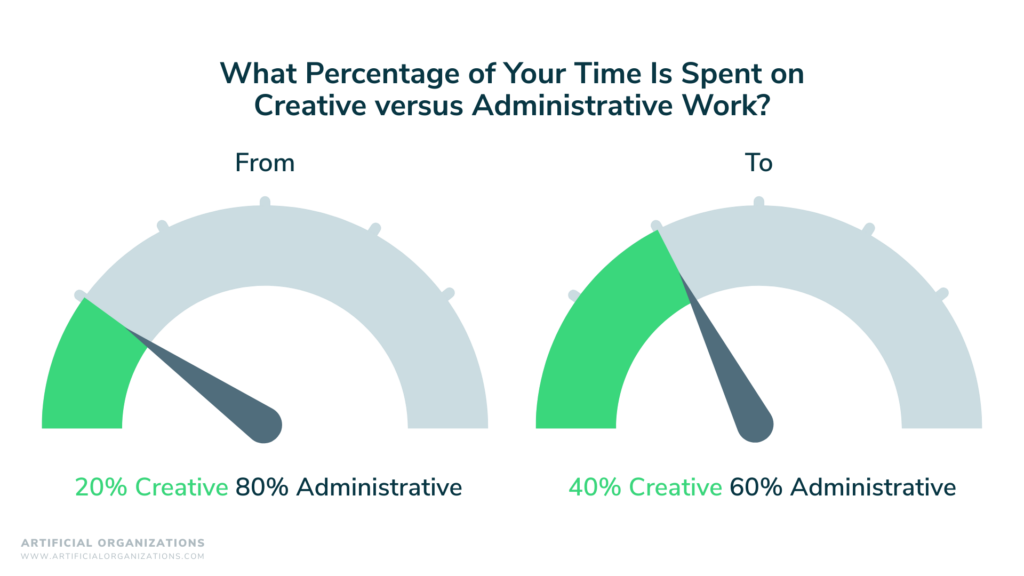
This misallocation creates the hidden friction of modern leadership. Leaders are drowning in context reconstruction instead of focusing on the work that matters most: thinking clearly about the future. AI changes this equation.
The Market Is Not Waiting
The shift is already underway.
Between October 2025 and February 2026, Amazon eliminated 30,000 middle-management roles as part of a broader effort to flatten decision layers and accelerate execution.
At the same time, companies are aggressively competing for AI-capable talent. In 2025, Meta reportedly spent over $300 million recruiting top AI engineers.
The economic signals are becoming impossible to ignore.
By early 2026, workers with AI-related skills commanded a 23% wage premium — higher than the premium associated with most advanced degrees. The labor market is reorganizing rapidly.
Research from the Burning Glass Institute analyzing millions of job postings after the release of ChatGPT revealed something important:
- Skills exposed to automation were 16% more likely to decline in demand.
- Skills that augment AI were 7% more likely to increase.
But the deeper insight lies in how those trends overlap.
Across 759 occupations, automation exposure and augmentation exposure were strongly positively correlated (r = 0.87). That means the same roles being automated are also being augmented. AI is not eliminating knowledge work. It is redesigning it from within.
The project manager whose scheduling tasks are automated is the same project manager whose strategic responsibilities expand. The financial analyst who no longer builds models from scratch is the same analyst who now interprets and challenges AI-generated output.
The unit of change is not the job. It is the judgment required for the job, and this is where many leaders misunderstand what is happening.
AI isn’t replacing leaders. It’s exposing them.
Leaders who rely on manual preparation and fragmented information will increasingly be outpaced by leaders who augment their thinking with AI.
The difference may not be obvious at first. But over time, it compounds. One leader arrives in the room having spent hours reconstructing context. Another arrives having pressure-tested the issue, explored multiple perspectives, and clarified decision paths before the discussion even begins. The advantage becomes obvious quickly.
As NVIDIA CEO Jensen Huang put it: “AI won’t take your job. But someone who knows how to use it will.”
From Tool to Thinking Partner
Most people treat AI like a productivity tool. They ask it to write emails, summarize documents, or generate presentations. Those uses are helpful but they barely scratch the surface. The real leadership advantage appears when AI becomes a thinking partner.
Instead of generating output, AI helps leaders interrogate their reasoning. Leaders can ask questions such as:
- What assumptions am I making?
- What alternative interpretations exist?
- What risks might I be overlooking?
- How would a skeptical stakeholder challenge this idea?
This shifts AI from producing answers to improving thinking.
When leaders embed AI into their daily workflow, something powerful begins to happen—we call it the CTSA Loop.
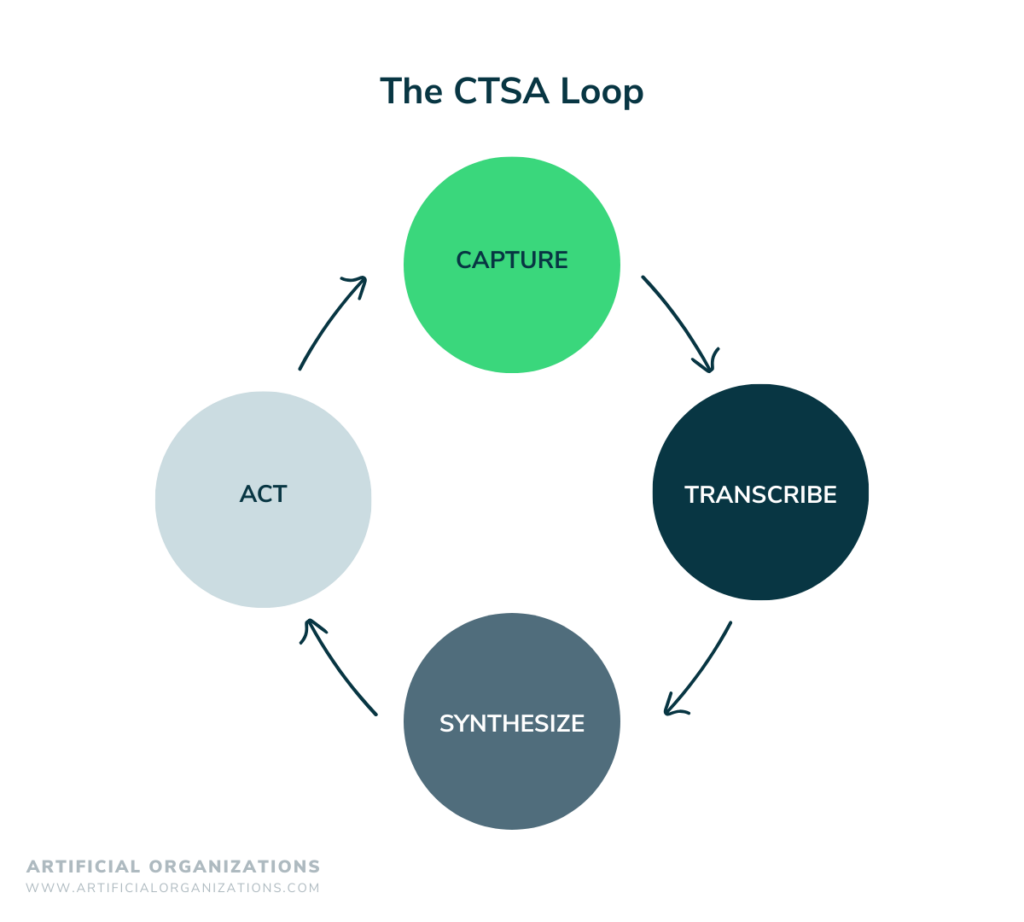 Capture → Transcribe → Synthesize → Act
Leaders begin by capturing conversations and decisions rather than letting them disappear across fragmented tools and inboxes.
AI then transcribes those conversations into searchable information.
It synthesizes themes, risks, and unresolved issues, allowing leaders to interrogate the material quickly.
Finally, leaders act on those insights, making decisions with clearer context. Those decisions generate new conversations and new information, feeding the loop again.
Over time the organization develops something powerful: institutional memory and faster judgment.
The result is not just productivity. It is compounding decision advantage.
A Case Study: Starting With Yourself at Skyscanner
Andrew Phillips, CTO of Skyscanner, operates inside one of the most complex digital systems in travel.
The platform serves more than 160 million monthly users and processes billions of flight price checks every day.
Yet when Andrew began exploring AI, he didn’t start with a transformation program.
He started with a personal question: “Is this actually making my day better?”
Like most executives, his schedule was packed with leadership meetings, architectural reviews, and strategy discussions. The challenge wasn’t lack of information. It was holding context across dozens of decisions. Instead of launching a company-wide initiative, Andrew began experimenting inside his own workflow.
Some experiments worked. Others didn’t. He shared both openly with his teams. That behavior created something powerful: permission to experiment.
Over time those experiments spread across the organization. AI stopped being a technology initiative. It became a learning process embedded in leadership behavior.
Organizational change began not with technology, but with leadership experimentation.
Two Types of Leaders Are Emerging
Across organizations, two distinct leadership patterns are beginning to appear.
The difference is not intelligence or experience.
It is how leaders choose to work with AI.
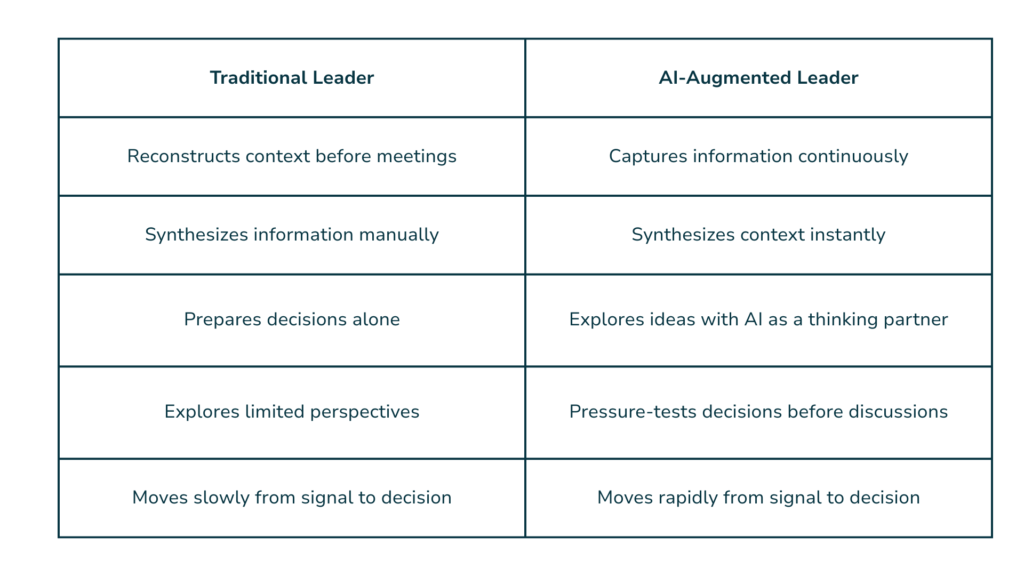
The gap between these approaches will widen.
And eventually it will define which leaders — and which organizations — move fastest.
The Decision Advantage
Organizations rarely fail because they lack information. They fail because they make decisions too slowly.
Research from Bain & Company found organizations that excel at decision-making outperform peers financially by up to 95 percent.
AI accelerates decision-making by shortening the distance between signal and judgment.
When information is captured automatically, synthesized instantly, and explored interactively, leaders can focus on the work that matters most: making better decisions faster.
This is where decision velocity increases and decision advantage begins to compound.
The Leadership Question
AI will not replace leaders but it will change how leadership works.
Some leaders will continue preparing the way they always have, manually gathering information, reconstructing context, and synthesizing insights alone.
Others will redesign how they work. They will integrate AI into their thinking. They will pressure-test ideas before presenting them. They will arrive in the room with clarity others struggle to match.
And over time, that difference will compound.
Because the leaders who build AI into their thinking processes will not simply work faster. They will make better decisions faster than everyone else in the room.
And in a world defined by uncertainty and accelerating change, that may become the most important leadership advantage of all.
FAQ:
Q1. Will AI replace leaders?
AI will not replace leaders. It will replace leaders who don’t adapt. Those who integrate AI into their thinking will make faster, better decisions and outperform others.
Q2. Why is AI changing leadership now?
AI reduces time spent gathering and processing information, shifting leadership toward judgment. Decision speed and quality now matter more than managing tasks or workflows.
Q3. What does it mean to use AI as a thinking partner?
Using AI as a thinking partner means testing assumptions, exploring alternatives, and challenging decisions. It helps leaders improve how they think, not just what they produce.
Q4. What is the biggest mistake leaders make with AI?
The biggest mistake is treating AI as a productivity tool. Leaders who only use it for output miss its real value in improving decision-making and judgment.
Q5. How does AI improve decision-making for leaders?
AI captures and synthesizes information quickly, helping leaders see patterns, evaluate trade-offs, and make decisions with clearer context and greater confidence.
References:
- O’Reilly, Barry. AI Productivity for Executives (Podcast with Andrew Phillips).
- Perlow, L. A., Hadley, C. N., & Eun, E. How to Free Up Time for Meaningful Work. Harvard Business Review.
- O’Reilly, B. Why AI Maturity Models Don’t Work.
- Burning Glass Institute. Beyond the Binary: AI and the Future of Work.
- Bain & Company. Score Your Organization to Improve Decision Effectiveness.