The 3T Model: How Leaders Accelerate with AI-Augmented Leadership
Most leaders begin their AI journey in the wrong place. They start with tools.
New copilots, new assistants, or automations based on the latest and greatest tool they heard about that week.
The result is predictable. Some productivity improves, but leadership performance rarely changes in a meaningful way.
That is because the real opportunity with AI is not tool adoption. It is leadership augmentation.
The leaders who accelerate fastest with AI follow a different sequence. Instead of starting with tools, they start by redesigning how they work.
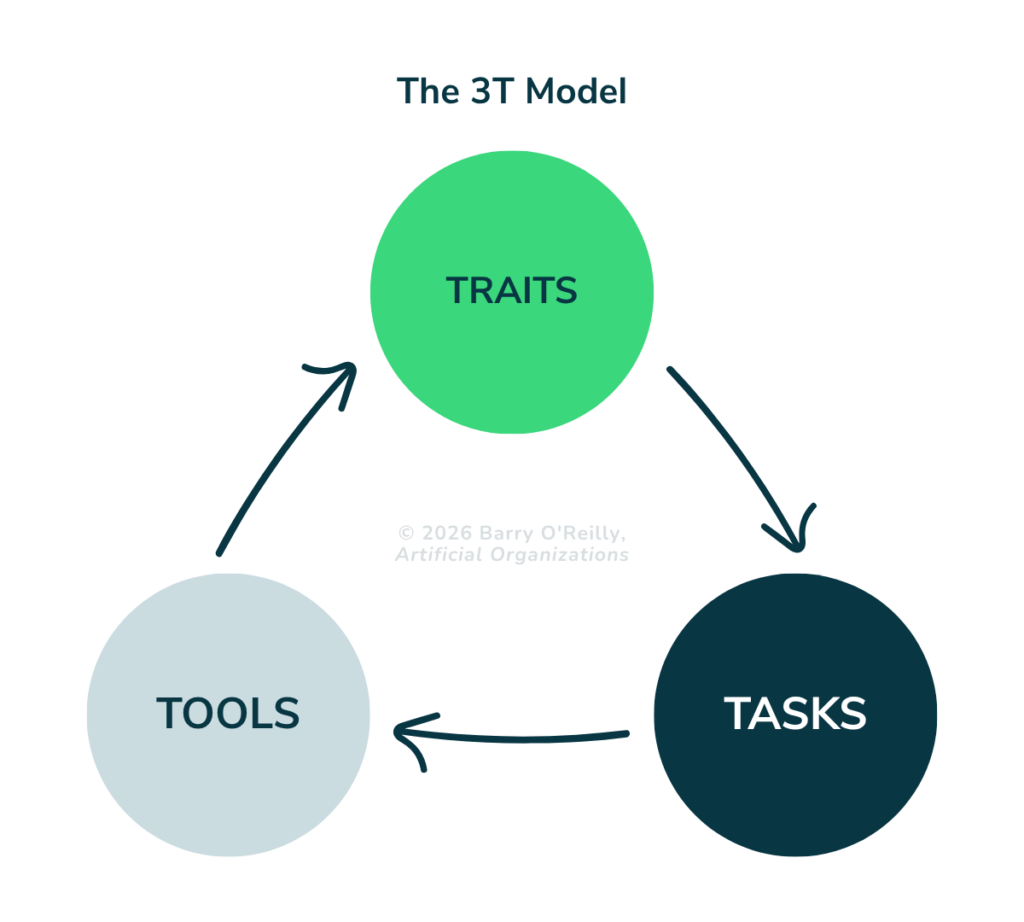
In Artificial Organizations, I call this the 3T Model:
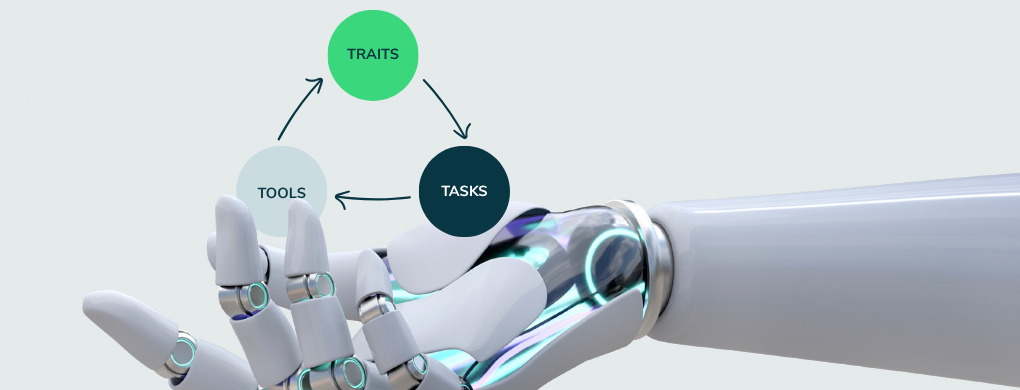
Traits → Tasks → Tools
This sequence matters more than most leaders realize.
When leaders invert it, they amplify noise. When they respect it, AI becomes a multiplier.
The Real Constraint in Leadership
Organizations today are drowning in information. Dashboards multiply. Reports increase. Data becomes more accessible than ever. Yet leaders are not experiencing greater clarity.
The constraint is not access to information. It is judgment capacity.
Leadership advantage today comes from two forces working together:
- decision velocity — how quickly leaders move from signal to decision
- decision advantage — how well-informed and pressure-tested those decisions are
Speed without insight creates chaos. Insight without speed creates irrelevance. When the two compounds together, leadership itself changes shape.
AI has the potential to dramatically improve both, but only if leaders redesign how they work.
The Mistake Most Leaders Make
When leaders first explore AI, they experiment with tools.
They try ChatGPT. They test Copilot. They experiment with Perplexity.
These tools can be powerful. But without a clear leadership system behind them, they often become another layer of complexity.
The real leverage does not come from executing tasks more productively. It comes from redesigning how decisions move through your system. That is where the 3T Model comes in.
The 3T Model
The 3T Model helps leaders align AI with how they actually think and work.
The sequence is simple:
Traits → Tasks → Tools
It is not a productivity framework. It is judgment infrastructure design.
Traits: How You Naturally Think
The first step is understanding how you work at your best.
Every leader has natural cognitive patterns. Some leaders think best by talking ideas through. Others prefer writing, sketching, or analyzing quietly.
The book identifies several common leadership traits:
- verbal — talking, debating, storytelling
- visual — writing, mapping ideas, sketching
- receptive — listening and observing
- analytical — structured reasoning and problem solving
- physical — walking, prototyping, experimenting
These are not preferences. They are sources of leverage.
Most leaders never design their work around them. Instead, they inherit workflows that reward endurance, responsiveness, and visibility. AI flips that equation.
When machines handle administrative tasks such as capture, recall, and synthesis, leadership value centers on judgment. Understanding your traits is the first step to amplifying that judgment.
Tasks: Where Your Judgment Creates Value
Once leaders understand their traits, the next step is identifying their highest-leverage tasks.
Every leadership role contains two types of work.
High-leverage tasks:
- strategic thinking
- Synthesis
- Coaching
- Judgment
- Decision making
And what I call (necessary) time-suck tasks:
- typing notes
- rewriting updates
- hunting for documents
- summarizing conversations
- preparing slides
AI is built for these administrative tasks. You are built for the high-leverage work.
When leaders automate administrative friction, they create space for the work only they can do. This shift alone can dramatically increase leadership capacity.
Tools: The Last Step, Not the First
Only after leaders understand their traits and tasks should they choose tools.
When tools align with how leaders think and the work they need to perform, they become multipliers rather than distractions.
Different tools serve different leadership functions.
Large language models such as ChatGPT or Claude are excellent for synthesis, strategic framing, and decision preparation.
Research engines such as Perplexity or Elicit are useful for fast, cited research.
Custom prompts or AI agents can accelerate recurring decision workflows.
But the power move is not the tool, it is the discipline of aligning tools with judgment tasks.
The leverage isn’t in using more tools. It is in knowing which tool sharpens thinking for the task at hand.
AI as a Thinking Partner
The most powerful shift leaders experience is when AI stops being a tool they use and becomes a thinking partner.
Instead of asking AI to produce answers, leaders use it to sharpen their thinking.
- They clarify decisions.
- They pressure test assumptions.
- They generate strategic options.
- They rehearse arguments before entering high-stakes discussions.
This approach dramatically accelerates executive preparation.
In one case study from the book, Misty Shafer Sterne, the Vice President of Commercial Technology at American Airlines, the world’s largest airline, shared how she used AI as a thinking partner while preparing strategy and executive communication.
Misty recognizes that her best thinking doesn’t always happen in strategy sessions. Her best ideas often come while she’s moving–walking through an airport terminal or driving home—or in quiet moments between meetings.
Talking it out is her natural trait and a true talent. Once she started capturing voice notes and running them through AI, her thinking became a multiplier. She:
- shaped new geo-location operating models
- developed revenue ideas
- captured performance feedback for her team
- refined strategies far faster than before
At the same time, she noticed clear benefits:
- ideas stopped getting lost
- strategy work happened in micro-moments
- intuition turned into structured plans
- preparation time dropped dramatically
She didn’t find any more hours. She found leverage in small fractions of time compounded throughout her day.
We see this in numerous leaders we work with:
- Preparing research for a board presentation dropped from six hours to ninety minutes.
- Writing department-wide updates dropped from three hours to thirty minutes.
- High-stakes meeting summaries dropped from an hour to ten minutes.
The real benefit, however, is not time savings. It was clarity.
Misty used AI as a thinking partner and amplified her natural traits by pairing the right tasks with the right tools. As a result, she showed up feeling more prepared, more confident, and more present in leadership conversations.
The Executive Decision Engine
Most executive workflows follow the same pattern.
- Information is captured.
- Insights are summarized.
- Issues are classified.
- Decisions are distributed.
- Outcomes are tracked.
AI collapses the friction across this entire system.
For example, conversations from meetings, Slack threads, or emails can be captured automatically. AI can synthesize these inputs into structured decision briefs. Leaders arrive at meetings already prepared. Decisions are clearer. Follow-up becomes automatic. Over time, these workflows compound into a leadership operating system.
The Performance Impact
When leaders implement AI-augmented workflows effectively, the results are measurable.
Leaders in organizations adopting our AI leadership operating system report:
- 30–50% reduction in time from issue surfaced to decision made
- 2–3× increase in meaningful decisions per quarter
- 40–60% reduction in executive preparation time
- higher follow-through rates and fewer decision reversals
The biggest gain is not speed alone. It is confidence during uncertainty.
AI does not make leaders decisive. It removes the friction that keeps them indecisive.
The Real Transformation
The biggest shift leaders experience with the 3T Model is not technical, it is behavioral.
They stop treating AI as a productivity hack. They begin using it as a judgment infrastructure.
They capture their thinking. They pressure test ideas earlier. They arrive prepared. They decide faster. Over time, this produces a widening leadership advantage. Decision velocity increases, decision advantage improves and leadership presence strengthens.
The Leaders Who Move First
The leaders who adopt this model early will not simply become more productive. They will become structurally better decision makers.
They will show up to critical moments with clearer thinking. They will prepare faster than their peers. They will navigate uncertainty with greater confidence, and they will compound advantage over time.
The question leaders must now ask themselves is simple: are you experimenting with AI tools or are you redesigning how you lead?
Because the leaders who align Traits, Tasks, and Tools will not just use AI better.
They will outperform everyone else in the room.
FAQ
Q1. What is the 3T Model?
The 3T Model is a framework that helps leaders use AI effectively by aligning Traits, Tasks, and Tools to improve decision-making and performance.
Q2. What does Traits → Tasks → Tools mean?
It means leaders should first understand how they think, then identify high-leverage tasks, and only then choose AI tools that support those workflows.
Q3. Why do most leaders struggle with AI adoption?
Most leaders start with tools instead of redesigning how they work, which leads to more complexity without improving leadership performance.
Q4. How does the 3T Model improve decision-making?
It improves decision velocity and clarity by aligning AI with how leaders think and where their judgment creates the most value.
Q5. What are high-leverage tasks for leaders?
High-leverage tasks include strategic thinking, synthesis, coaching, and decision-making—work where human judgment creates the most impact.
Q6. How should leaders use AI in practice?
Leaders should use AI to handle administrative work like capture, summarization, and preparation, so they can focus on thinking, decisions, and leadership.