
AI as a Thinking Partner: The Leadership Shift Most Organizations Haven’t Made Yet
Most leaders experimenting with AI start in the wrong place. They start with productivity.
They ask AI to write emails, summarize documents, or generate presentations. These capabilities are impressive and useful, but they only scratch the surface of what AI can do for leadership.
The real opportunity is not productivity, it is thinking.
The leaders gaining the greatest advantage from AI are not using it primarily to execute tasks faster. They are using it as a thinking partner to sharpen judgment, pressure-test ideas, and prepare better decisions.
This shift is subtle, but its impact is profound. When AI becomes part of a leader’s thinking process, it begins to influence how decisions are formed, how problems are framed, and how organizations move from insight to action.
The Hidden Bottleneck in Leadership
Leadership has always been a thinking profession.
Executives are paid not to produce documents or process information, but to exercise judgment under uncertainty. Yet much of a leader’s time is consumed by work surrounding decisions rather than the decisions themselves.
Research consistently shows that executives spend enormous amounts of time preparing for decisions: gathering information, summarizing conversations, and reconstructing context before meetings.
In the Artificial Organizations AI Executive Study (2025), leaders reported spending between 30–40% of their week preparing for meetings, gathering information, and synthesizing context before key decisions. This reflects broader industry research from HBR showing senior executives spend more than 23 hours per week in meetings, with additional hours spent preparing for them.
This preparation work is necessary, but it creates friction. When leaders spend hours assembling context, they have less time for the work that matters most: interpreting signals, exploring alternatives, and making confident decisions. This is where AI changes the equation.
The Shift from Tool to Thinking Partner
Most people use AI like a tool. They give it a prompt and expect an answer.
Leaders who unlock its real power use it differently. They use AI to interrogate their thinking.
Instead of asking AI to produce finished output, they engage it in a dialogue that helps refine their judgment. They explore questions such as:
- What assumptions am I making here?
- What alternative interpretations exist?
- What risks might I be overlooking?
- How would a skeptical stakeholder challenge this idea?
This process transforms AI from a generator of content into a partner in reasoning. Rather than replacing human judgment, AI amplifies it.
The Executive Preparation Advantage
One of the most powerful applications of AI as a thinking partner appears in executive preparation.
Consider how leaders traditionally prepare for a major meeting. They review documents, scan reports, read previous notes, and try to reconstruct what happened in earlier discussions. This process is slow and often incomplete.
With AI integrated into leadership workflows, preparation changes dramatically. Captured meeting transcripts, written updates, and research materials can be analyzed by AI to produce structured summaries of key issues. Leaders can then explore these summaries interactively.
- What decisions are pending?
- Where do opinions diverge?
- What information is still missing?
This approach dramatically accelerates preparation time while increasing clarity.
In the Artificial Organizations AI Executive Study (2025), leaders using AI-assisted preparation reported 30–50% faster decision cycles and significant reductions in time spent gathering information before meetings.
The benefit is not simply time saved, it is better thinking under pressure.
A Case Study: Preparing for the Executive Room
One executive featured in Artificial Organizations began experimenting with AI as a thinking partner while preparing for leadership meetings.
Previously, preparing for these sessions required several hours of work. The executive would review documents, read through email threads, and attempt to reconstruct the key issues discussed in earlier meetings before the next discussion began.
After integrating AI into the preparation workflow, the process changed.
Meeting conversations were automatically captured and transcribed. AI tools were then used to summarize prior discussions, highlight unresolved issues, and surface key themes that had emerged across conversations. Instead of manually reviewing multiple sources of information, the executive could quickly explore a structured overview of the situation.
Preparation time dropped from several hours to roughly ninety minutes.
But the most meaningful change appeared in the meeting itself. Instead of spending the early part of discussions reconstructing context, the executive arrived with a clearer understanding of the issues, the assumptions being made, and the possible decision paths ahead.
As a result, discussions moved more quickly to the substance of the decision. Questions became more focused, and the group was able to spend more time evaluating trade-offs rather than reviewing background information.
The executive later reflected that the biggest difference was not the time saved in preparation, but the quality of thinking it enabled: “I arrived prepared in a way that wasn’t possible before.”
Pressure-Testing Decisions Before They Happen
Another powerful application of AI as a thinking partner is decision rehearsal.
Leaders frequently enter high-stakes conversations where clarity, judgment, and executive presence matter—board meetings, investor discussions, and strategic reviews.
In these situations, the quality of preparation often determines the quality of the outcome.
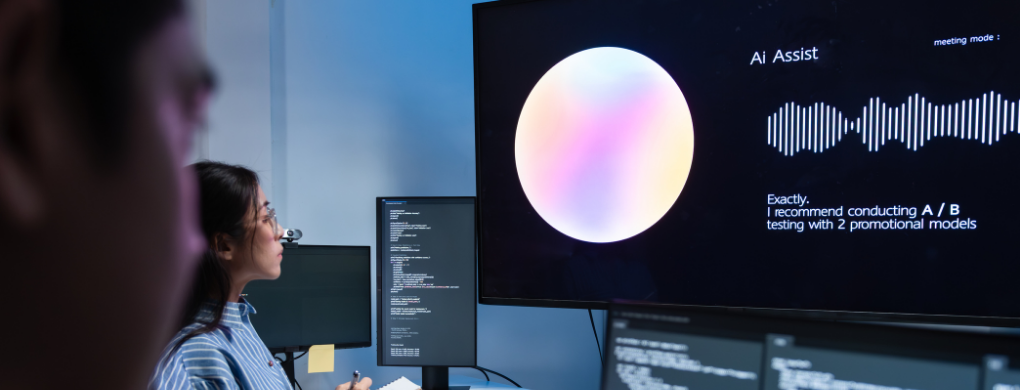
To explore this further, we introduced a simple experiment with the same executive, the CEO-bot: an AI system designed to act as a challenging counterpart during preparation.
The system was configured to question assumptions, raise alternative interpretations, and surface potential counterarguments while the executive prepared for upcoming conversations with the CEO and board.
In practice, this meant the executive could test their thinking before entering the room. If a strategy had weaknesses, the system would highlight them. If a proposal lacked supporting evidence, it would prompt further exploration. If a line of reasoning was unclear, the executive could refine it in advance.
This process is not entirely new. Many experienced leaders already pressure-test ideas with trusted colleagues or advisors.
The difference with AI is speed and accessibility.
Instead of waiting for the next conversation with a peer or mentor, leaders can explore multiple perspectives immediately, refining their thinking in real time.
The result was noticeable. The executive entered discussions with clearer framing, stronger reasoning, and greater confidence in the arguments they presented. Colleagues began to comment on the clarity of preparation and the quality of contributions in leadership meetings.
Over time, this kind of preparation does more than improve individual performance. It strengthens the overall decision process of the organization.
Leaders arrive with clearer thinking. Conversations move more quickly to the real issues. And decisions happen earlier and with greater confidence.
The Research on Decision Quality
Research increasingly shows that organizations that make high-quality decisions quickly outperform competitors. Bain & Company’s work on decision effectiveness found that companies that excel at decision-making outperform peers financially by up to 95 percent.
Yet most organizations struggle to improve decision quality because the process surrounding decisions is slow and fragmented. Information is scattered. Context must be reconstructed. Perspectives are incomplete. AI reduces this friction.
When leaders have access to synthesized context and can explore issues interactively, they move more confidently from signal to judgment. This is where decision velocity and decision advantage begin to compound.
Thinking Systems, Not Thinking Alone
One of the most important insights from the Artificial Organizations work is that leadership is rarely an individual activity. Leaders operate inside systems. Information flows through those systems. Decisions move through those systems. Knowledge accumulates within those systems. AI allows organizations to design systems that support thinking itself.
Captured conversations feed into AI analysis. Insights are synthesized into decision briefs. Leaders explore those briefs with AI before making decisions. Over time this creates a feedback loop. The organization becomes progressively better at understanding its own information. Leadership thinking becomes more structured, more informed, and more consistent.
The shift to AI as a thinking partner does not require a massive transformation. It begins with small habits. Leaders begin capturing their meetings and conversations. They explore those transcripts using AI. They ask AI to challenge assumptions before making decisions. They use AI to clarify issues before entering important discussions.
Over time these habits reshape how leaders think. Preparation becomes faster, clarity increases and decisions accelerate.
The Competitive Advantage of Thinking Faster
In the coming decade, organizations will not compete primarily on who has access to AI tools. Those tools are rapidly becoming available to everyone. The real competitive advantage will come from how leaders integrate AI into their thinking processes.
Leaders who treat AI as a productivity assistant will see incremental gains. Leaders who treat AI as a thinking partner will experience something very different. Their preparation improves. Their reasoning sharpens. Their organizations move from information to decision faster than competitors.
We see this consistently in the leaders we work with through the Artificial Organizations programs and executive coaching. Once leaders begin using AI as a thinking partner in their leadership workflows, the impact becomes measurable. Executive preparation time drops significantly. Meeting context is reconstructed in minutes instead of hours. Leaders report clearer framing of strategic issues and greater confidence in the decisions they bring to their teams.
In the Artificial Organizations AI Executive Study (2025), leaders experimenting with AI-augmented decision workflows reported 30–50% faster decision cycles, along with meaningful reductions in time spent preparing for meetings, summarizing conversations, and gathering context before making decisions. Several executives also reported a noticeable shift in the quality of their leadership conversations. With less time spent reconstructing information, discussions focused more quickly on judgment, trade-offs, and action.
Over time this difference compounds. Decision velocity increases, decision advantage strengthens, and leadership itself evolves.
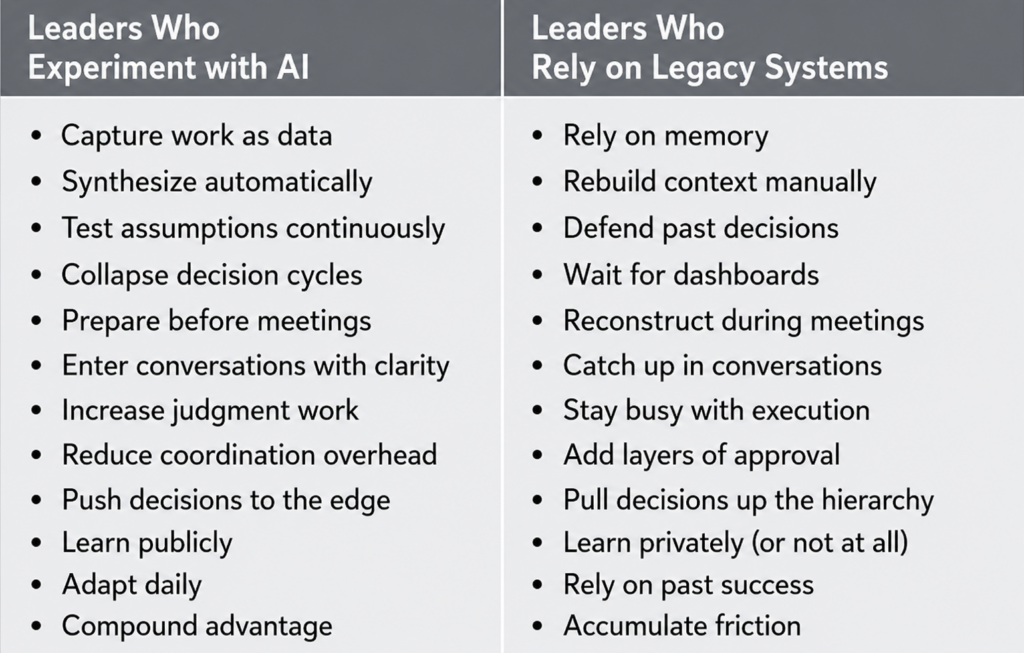
Organizations that redesign how leaders think with AI are not simply becoming more efficient. They are building a structural advantage in how quickly they interpret signals, explore options, and act with confidence.
And in environments defined by uncertainty and rapid change, thinking faster and deciding better may become the most important competitive advantage of all.
The Leadership Question for You
AI will not replace leaders. But it will change how leadership works.
The most effective leaders of the next decade will not simply manage people and resources. They will design systems that amplify thinking.
The question leaders must now ask themselves is simple. Are you using AI to produce more content? Or are you using it to think better?
Because the leaders who build AI into their thinking processes will not simply work faster.
They will make better decisions, faster than everyone else in the room.
FAQs
Q1. What does it mean to use AI as a thinking partner?
Using AI as a thinking partner means engaging it to refine ideas, challenge assumptions, and improve decision-making rather than just generating outputs.
Q2. How is AI as a thinking partner different from using AI for productivity?
Productivity use focuses on tasks like writing or summarizing. A thinking partner approach focuses on improving judgment, preparation, and decision quality.
Q3. Why is decision-making still slow in organizations today?
Leaders spend a significant amount of time gathering information, reconstructing context, and preparing for meetings instead of focusing on decisions themselves.
Q4. How does AI improve executive preparation?
AI analyzes transcripts, documents, and data to create structured summaries, helping leaders prepare faster and with greater clarity before decisions.
Q5. How can leaders use AI to improve decision quality?
Leaders can use AI to pressure-test ideas, explore alternative perspectives, and identify risks before entering high-stakes discussions.
Q6. What is the competitive advantage of using AI as a thinking partner?
Leaders who integrate AI into their thinking processes improve decision speed and clarity, creating a structural advantage in how organizations operate.