The CTSA Model: How Leaders Turn AI Into Decision Advantage
Many leaders experimenting with AI are discovering something surprising. The real value is not writing emails faster, summarizing documents, or generating presentations. Those improvements are useful, but they are incremental.
The real leverage of AI appears when leaders redesign how decisions move through their organization.
In Artificial Organizations, I describe this as the CTSA Model:
Capture → Think → Synthesize → Act
This model transforms AI from a productivity tool into decision infrastructure. When implemented properly, it dramatically increases decision velocity and decision advantage across teams.
The Real Bottleneck in Leadership
Organizations rarely struggle because of a lack of information.
The majority of companies generate enormous amounts of data: dashboards, analytics, reports, meeting notes, Slack conversations, and email threads. The challenge is not information scarcity. It is signal extraction.
Leaders spend an extraordinary amount of time trying to understand what is happening, what matters, and what decision needs to be made next.
Research from Bain & Company shows senior executives spend more than two days each week in meetings, with even more time spent preparing—gathering information, summarizing discussions, and reconstructing context before decisions are made.
This is not where leadership value is created. Leadership value is created when leaders interpret information, exercise judgment, and make decisions.
The CTSA Model removes friction from everything surrounding that judgment.
The CTSA Model
The CTSA Model describes how AI can support the natural flow of leadership work.
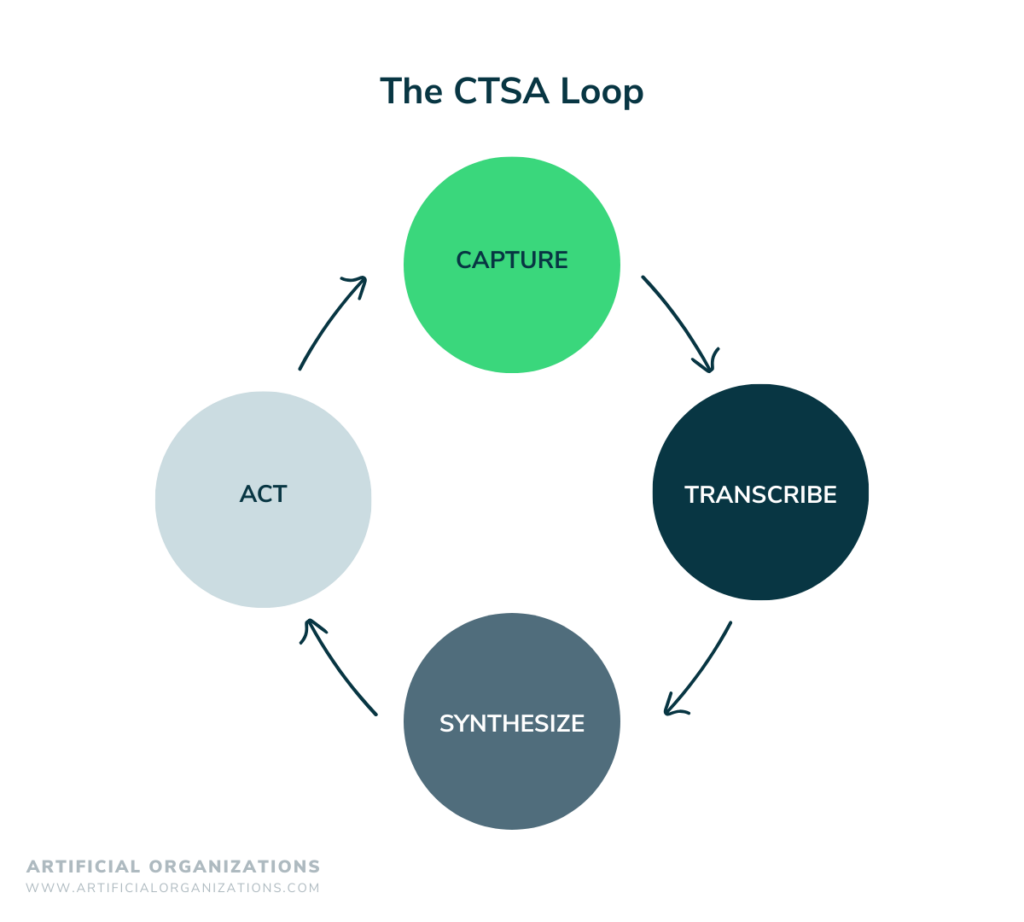
Capture → Transcribe → Synthesize → Act
Each step strengthens the next, creating a compounding loop.
Instead of constantly reconstructing context, leaders move through decisions with clarity and momentum.
Over time this becomes the operating rhythm of an Artificial Organization, which we define as, companies that deliberately combine human judgment with machine intelligence to redesign how decisions are made, how knowledge flows, and how work improves over time.
Capture: Recording Organizational Intelligence
The first step is capturing information automatically.
Most organizations lose enormous amounts of valuable insight every day. Important discussions happen in meetings. Decisions are debated in Slack threads. Ideas emerge in hallway conversations or voice notes. Yet very little of this information is structured or preserved.
AI changes this.
Meeting transcripts, call recordings, notes, and conversations can now be captured automatically. Instead of relying on memory or fragmented notes, leaders begin with a reliable record of what actually happened. This captured information becomes the raw material for organizational intelligence.
In many companies, simply implementing automated capture reveals how much valuable context was previously disappearing. Leaders stop asking, “What was decided last week?” or “Who said what?” because the system already knows.
Transcribe: Turning Information Into Usable Intelligence
Once information is captured, the next step is transcription. This is where AI begins transforming raw conversations into usable organizational intelligence.
Meetings, calls, voice notes, and discussions contain enormous amounts of valuable information, but historically much of that insight disappears the moment the conversation ends. Notes are partial, memories are imperfect, and context gets lost.
AI changes this dynamic by transcribing conversations automatically and accurately, creating a reliable record of what was actually said.
Instead of relying on fragmented notes or recollection, leaders now have a searchable record of discussions across meetings, calls, and collaborative conversations.
This is where AI becomes a powerful thinking partner.
Once conversations are transcribed, leaders can interrogate the material through questions.
- What themes are emerging?
- What risks were mentioned?
- What unresolved issues remain?
- Where do opinions diverge?
AI allows leaders to explore these transcripts quickly and deeply.
Instead of scanning hundreds of messages or notes manually, they can surface the underlying signal within minutes. Important context that once required hours of reconstruction can now be accessed instantly.
This dramatically accelerates how leaders develop situational awareness.
It is also one of the first places where decision velocity begins to increase. Leaders arrive at discussions with a clearer understanding of what has happened, what issues remain open, and what decisions are required next.
Synthesize: Clarifying the Decision
Once insights emerge, they must be synthesized.
Most leadership decisions fail not because the analysis was wrong but because the issue was never framed clearly.
- What exactly are we deciding?
- What are the options?
- What assumptions are we making?
- What trade-offs exist?
AI excels at synthesis. It can transform messy conversations and scattered information into structured decision briefs.
These briefs often include:
- a summary of the issue
- key insights and context
- possible options
- risks and constraints
- recommended next steps
When teams arrive at meetings with this level of preparation, the conversation changes. Instead of reconstructing context, leaders focus on judgment. This is where decision advantage begins to emerge.
Act: Accelerating Execution
The final stage is action.
Once a decision is made, execution often slows down again. Tasks must be assigned. Communication must be written. Updates must be shared.
AI can streamline much of this work.
- Decision summaries can be generated automatically.
- Follow-up actions can be captured and distributed.
- Communication to stakeholders can be drafted in minutes.
This allows teams to move from decision to implementation faster. Over time, organizations that operate this way develop a rhythm where decisions translate into action quickly and consistently.
A Case Example: Turning Meetings Into Decision Moments
Research from McKinsey shows executives spend nearly 40% of their time making decisions. Yet more than half say much of that time is spent inefficiently gathering information, aligning stakeholders, and reconstructing context before important decisions can be made.
One executive featured in Artificial Organizations began experimenting with the CTSA workflow across her leadership meetings.
Before implementing the system, meetings often followed a familiar pattern.
Leaders would spend the first half of the meeting reconstructing what had happened since the previous one. Updates were shared verbally, context had to be rebuilt, and decisions were frequently postponed because information was incomplete.
After implementing the CTSA approach, the workflow changed dramatically.
First, all leadership meetings were automatically recorded and transcribed.
Next, AI was used to extract key themes, open questions, and decision points from those conversations.
These insights were synthesized into short briefing documents before the next meeting. By the time the team gathered again, everyone already understood the context and the decision required. Meetings became dramatically shorter, discussions became sharper and decisions happened earlier.
The executive described the shift as moving from meetings about work to meetings for decisions.
The Research Behind Decision Speed
Research increasingly highlights the importance of decision speed in modern organizations.
In our Artificial Organizations AI Executive Study (2025), we saw leaders who integrated AI into decision preparation reported 30–50% faster decision cycles and significantly reduced time spent gathering information and preparing for meetings. Organizations adopting these AI-augmented workflows consistently reported clearer decisions and faster execution.
Faster decisions allow organizations to respond to market changes sooner, allocate resources more effectively, and learn from feedback cycles faster.
However, speed alone is not enough. Fast decisions without clarity lead to mistakes. The real advantage comes when organizations combine decision velocity with decision advantage.
AI-supported workflows like the CTSA Model allow leaders to improve both simultaneously. By removing friction from information capture, analysis, and synthesis, leaders can focus their attention where it matters most. Judgment.
Building the Decision Infrastructure
The most important shift leaders make when adopting the CTSA Model is recognizing that AI is not just another productivity tool, it is judgment infrastructure.
Organizations have long invested in systems that manage finance, operations, and logistics. Now leaders must build systems that support how the organization thinks.
- Capture ensures important information is never lost.
- Transcribe accelerates insight discovery.
- Synthesis clarifies decisions.
- Action translates judgment into execution.
Together, these stages form the backbone of an Artificial Organization.
The Compounding Effect
When the CTSA Model becomes embedded into leadership workflows, the benefits compound.
- Leaders spend less time reconstructing context.
- Teams arrive at meetings prepared.
- Decisions happen earlier in the conversation.
- Execution begins faster.
Over time, this creates a structural advantage. Organizations begin to move through problems more quickly than competitors. They recognize patterns earlier. They respond to opportunities sooner, and they learn faster.
The Leadership Question
Most leaders today are experimenting with AI tools. Some are writing emails faster. Others are generating research summaries or presentations. These are useful improvements but they are not where the real advantage lies.
The real advantage comes when leaders redesign how decisions move through the organization.
The CTSA Model offers a simple starting point.
- Capture what matters.
- Transcribe information to reuse and leverage.
- Synthesize decisions.
- Act quickly.
Leaders who build these workflows will not simply use AI more efficiently. They will build organizations that think and decide better.
And in the coming decade, that may become the most important competitive advantage of all.
FAQ
Q1. What is the CTSA model?
The CTSA model is a framework that helps leaders use AI to improve decision-making by capturing, transcribing, synthesizing, and acting on information.
Q2. How does the CTSA model improve decision-making?
It reduces time spent gathering and reconstructing information, allowing leaders to focus on interpreting insights and making decisions faster.
Q3. What does CTSA stand for?
CTSA stands for Capture, Transcribe, Synthesize, and Act.
Q4. Why is decision-making slow in organizations today?
Decision-making is slow because leaders spend too much time collecting information, aligning context, and preparing for decisions instead of making them.
Q5. How does AI support the CTSA model?
AI captures conversations, transcribes discussions, synthesizes insights, and helps execute decisions, reducing friction across the entire workflow.
Q6. What is decision velocity and why does it matter?
Decision velocity is how quickly an organization moves from insight to action. Faster decision cycles allow companies to respond, learn, and adapt more effectively.
Q7. What is the biggest mistake leaders make with AI?
The biggest mistake is using AI only for productivity tasks instead of redesigning how decisions move through the organization.