
How to Measure Whether AI Is Improving Cross-Functional Decisions
To measure AI decision-making, start with a harder question: did AI improve the decision, or only increase the activity around it?
One senior executive was proud of exactly that progress. Yet a review of the previous quarter revealed something important: no major decision had been made faster, no strategic call had changed, and no risk had surfaced earlier.
The organization had increased AI activity, but it had not improved the way decisions moved across the leadership team.
This is where many AI initiatives lose sight of value. A tool can make one task faster while the wider decision remains slow. Research may arrive sooner, but finance still challenges the assumptions late. A proposal may be drafted in minutes, but legal, operations, product, and sales still rebuild the context separately. The output improves while the decision system stays the same.
Deployment Is Moving Faster Than Evidence
Evident’s Q2 2026 research tracked 93 new AI use cases announced by 50 global banks, a quarterly record. Only 27% of those use cases disclosed an outcome, down from 41% in the previous quarter.
That research does not tell us whether each bank improved cross-functional decisions. It does reveal a broader measurement gap: organizations can scale AI faster than they can show what changed.
The answer is to measure the decision, not the tool.
Why Local Gains Disappear
Cross-functional decisions are difficult because no single team controls the whole journey. One function gathers evidence, another evaluates risk, another owns delivery, and a senior leader may hold the final authority. Each group can improve its own task while the overall process gains very little.
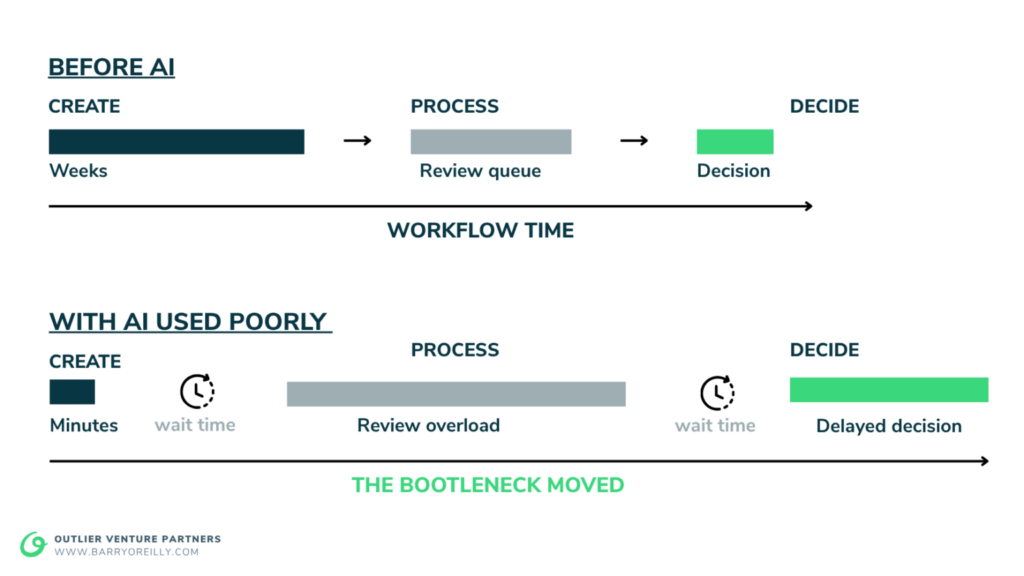
The diagram illustrates the Processing Pass-Off. AI reduces creation time from weeks to minutes, but the work still waits in the same review queue and the final decision arrives no sooner. The task gets faster while the wider workflow remains unchanged.
A marketing team might use AI to prepare a customer analysis in an hour instead of a day. If product questions the data, finance applies a different forecast, and legal only sees the proposal at the end, the decision may still take three weeks. The saved time is real, but the business value remains trapped inside one step.
This is why measuring individual productivity is not enough. Leaders need a baseline for the complete decision, from the first signal to the resulting action. Only then can they determine whether faster tasks are producing faster, better decisions.
Measure the Whole Decision Cycle
A useful way to measure cross-functional decisions is to examine the full decision cycle: Sense, Think, Decide, Act.
AI is useful when it strengthens this loop across functions, rather than optimizing an isolated task inside it.
Sense. Did the right people identify an important signal earlier? Measure the time between a change appearing and the team recognizing it. Track late surprises and avoidable escalations.
Think. Did the functions involved build a shared view faster? Measure preparation time, duplicated analysis, and the effort spent rebuilding context. A stronger process makes the options, assumptions, and trade-offs visible to everyone involved.
Decide. Did a clearly accountable owner make the call sooner? Measure total time to decision, the number of deferrals, and how often decisions are reopened. Faster analysis means little when the meeting still ends with a request for more information.
Act. Did the decision lead to coordinated action and a better result? Measure the time from decision to action, whether weak experiments stop quickly, and whether the intended customer or business outcome improves.
Across the full loop, keep two questions visible:
Who owns the decision? What evidence will show that it worked? Without clear ownership, cross-functional work turns into a series of handoffs. Without an agreed outcome, speed becomes the only visible result.
What Leaders Can Do Next
Start with one recurring cross-functional decision. It could be a pricing change, a product launch, a customer escalation, or a hiring plan.
- Review the last three examples and record how long the full decision took.
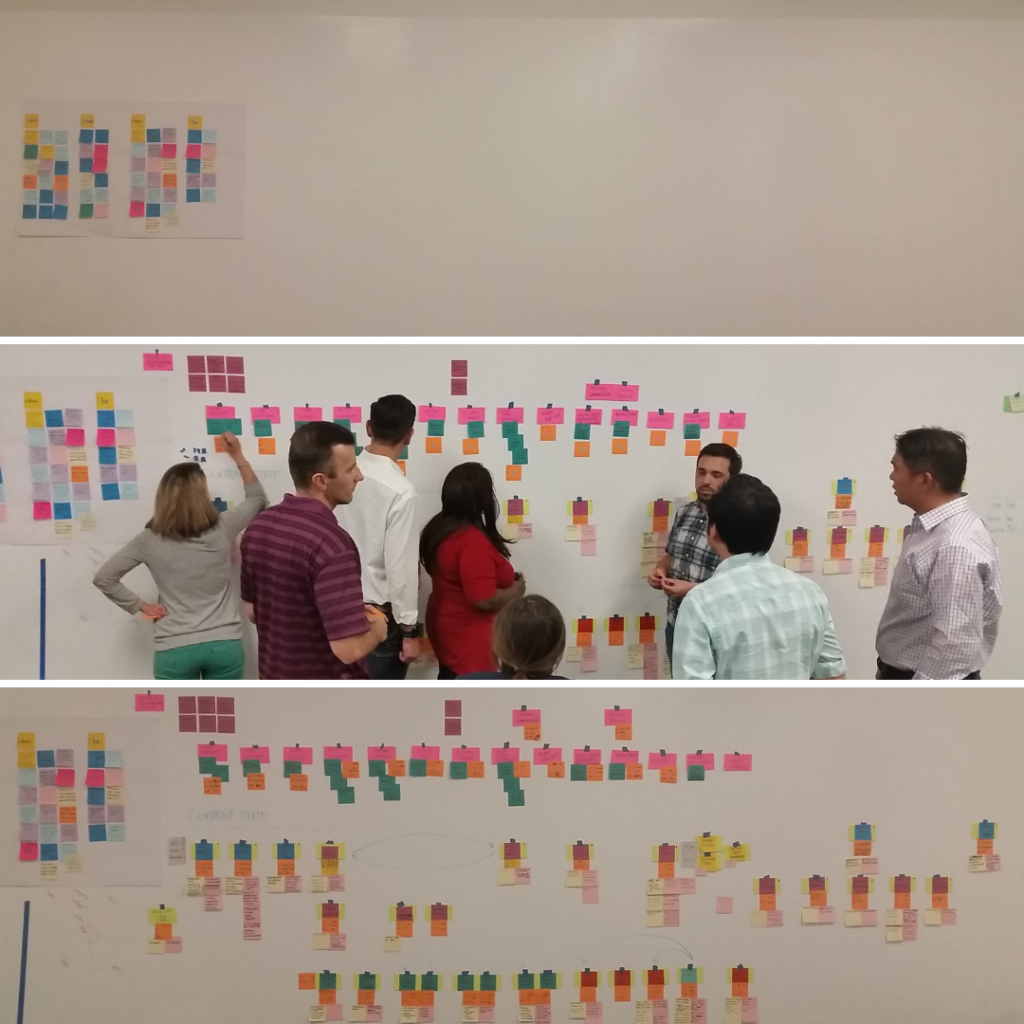
- Map where context was rebuilt, ownership became unclear, or the decision stalled.
- Name one accountable decision owner and the functions that must contribute.
- Choose one stage of the decision cycle where AI could help.
- Define the business evidence you expect to see within 30 days.
Then compare the new result with the baseline. If AI produces more material but the decision takes the same time, requires the same approvals, or leads to the same outcome, the organization has not improved.
Artificial organizations are built by redesigning how judgment flows between people and machines. The goal is a stronger judgment infrastructure: relevant signals surface earlier, teams understand the trade-offs, owners make clearer calls, and action follows. That is how leaders can tell whether AI is improving cross-functional decisions, rather than simply adding more activity around them.
Artificial Organizations Is Available in German
KI als Denkpartner brings the ideas from Artificial Organizations to German-speaking leaders exploring how human judgment and machine intelligence can improve decisions and ways of working.
Translated by Ignatius Furger, the German edition is available through Amazon Germany.
FAQs
Q1. How can leaders measure whether AI is improving cross-functional decisions?
Establish a baseline for the complete decision cycle before introducing AI. Then measure whether signals are identified earlier, shared analysis takes less time, decisions are made sooner, and action produces a better business or customer outcome.
Q2. Why are AI adoption and productivity metrics not enough?
Adoption shows that people are using AI, while productivity metrics may show that one task became faster. Neither proves that the wider workflow, decision, or organizational outcome improved.
Q3. What is the Processing Pass-Off?
The Processing Pass-Off occurs when AI helps one person complete a task faster but transfers more verification, interpretation, or decision-making work to someone else. The output arrives sooner, but the workflow and final decision remain slow.
Q4. What should organizations measure before introducing AI?
Organizations should record the current decision cycle time, preparation effort, handoffs, approvals, duplicated analysis, rework, ownership, and intended business outcome. These numbers provide the baseline needed to prove improvement.
Q5. Who should own an AI-enabled cross-functional decision?
A single business leader should be accountable for the decision and its outcome. Other functions can contribute evidence and expertise, but shared participation should not result in unclear ownership.
Q6. What evidence shows that AI has improved a decision?
Useful evidence includes shorter decision cycles, fewer deferrals, less duplicated analysis, faster action, earlier identification of risk, and measurable improvement in the intended business or customer outcome.